Blog
Legacy system modernization does not need a full replacement
By NETSOL Technologies Inc. , on November 18, 2026
A legacy system costs more than its maintenance bill. Each time it cannot finish a job, a person does it instead. That work grows with the book.
Table of Contents
Subscribe to our newsletter
Share this Blog:


Legacy system modernization does not mean replacing everything at once. You can move originations, servicing and collections to a modern platform one area at a time. The old core keeps running the contracts it already holds until they end, and you judge each step by what one contract costs to originate and service.
Why does an old core cost more as the auto loan book grows?
Household auto loan balances rose $21 billion to $1.73 trillion in the third quarter of 2026 (Federal Reserve Bank of New York, 2026). More contracts mean more work for the system, and whatever it cannot do on its own falls to your staff. Changes work the same way. A rule held in code waits for a release, so teams stop testing new ideas.
The Office of the Comptroller of the Currency (OCC) sees the risk too. Its Fall 2025 risk perspective warns that keeping legacy systems too long could raise the likelihood of outages, security vulnerabilities, maintenance challenges and weaker operational resilience (OCC, 2025). So the number to watch is what one contract costs to originate and service.
What do point solutions add around an old core?
When the core cannot change, teams buy tools to work around it, such as a pricing tool, a document service or a reporting extract. Each makes sense on its own. Together they add vendors, contracts and connections that all depend on the old core staying as it is.
That is vendor risk. Each tool ends up holding part of the process, so it is hard to remove one. The core, meanwhile, cannot change without breaking the tools around it.
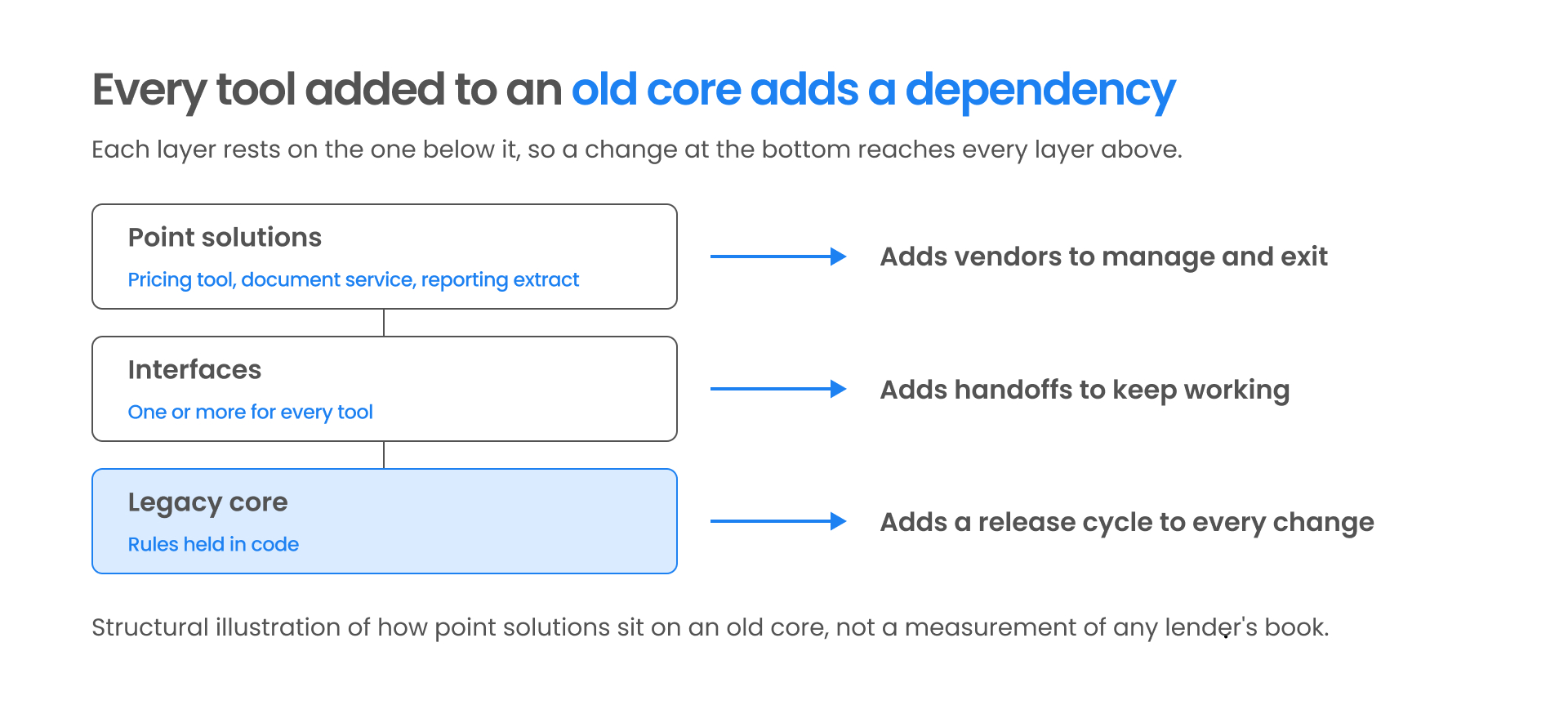
Figure: Each layer rests on the one below, so a change at the bottom reaches every tool above it.
Bank regulators already expect contingency plans for leaving a vendor. The Federal Reserve, the Federal Deposit Insurance Corporation and the OCC set that out in their Interagency Guidance on Third-Party Relationships. It says contract terms can protect a bank's ability to change providers without undue restrictions or cost (Board of Governors of the Federal Reserve System et al., 2023). The guidance covers banks, but any lender can ask the same question. Our blog on loan portfolio management software shows the same problem in reporting.
How does legacy system modernization work without replacing the core?
Move one area at a time, starting where a contract costs the most. New contracts go onto the modern platform, and the old core keeps servicing the ones it already holds. A contract that ends before its turn never has to move. Before each move, test the new platform on your real products and credit rules. Then run both systems side by side until the results match.
After each step, ask whether a contract now costs less and whether fewer vendors and connections depend on the old core. We cover the sequencing in more depth in our automotive finance whitepapers.
What this means for lending leaders
- Check what one contract costs to originate and service, not just the maintenance bill.
- Count the vendors and connections that depend on your core.
- Start with the area that costs the most and let the old core run off the rest.
Questions about legacy system modernization
What is legacy system modernization in auto finance?
It means moving a lender's originations, servicing and collections from an aging core to a current platform. It can happen in stages while the old core keeps running existing contracts.
How do point solutions create vendor risk for an auto lender?
Each tool holds part of your process and depends on the old core staying the same. You end up with more vendors and connections, and it gets harder to leave any one of them. Bank regulators expect a plan for that.
The real decision is the order you move things in
The choice is not whether to keep the old core or replace it. It is the order in which its jobs move. That order decides how many vendors and how much risk you carry through the change, so base it on the cost per contract you want to bring down. Whoever owns that cost should own the order.
Transcend Finance, our automotive finance software, offers origination, servicing and collections modules within a single, integrated platform. Its business rules and workflows are configurable. It integrates with surrounding systems through APIs and an integration hub. Which system in your stack would be hardest to switch off, and who owns the contract with its vendor?

Modernise your asset finance operations with NETSOL
Related blogs

Blog
Should every US dealership feature hybrids as sales rise?

Blog
Automotive retail solutions are only as good as the handoff

Blog