Blog
Loan portfolio management software for US auto lenders
By NETSOL Technologies , on October 2, 2026
Why a board can approve a growth plan that nobody is able to measure

Table of Contents
Subscribe to our newsletter
Share this Blog:


The board approves a plan for next year, with more volume in two segments and tighter appetite in a third. Twelve months later nobody can say whether it worked. The monthly pack reported accurately all year and still cannot answer the question.
Loan portfolio management software closes that gap only when every system counts a segment the same way. Origination, servicing and the ledger each hold part of the record. When they define a segment differently, you cannot compare portfolio performance across them. A plan set by segment then has nothing to report against.
The exposure a portfolio pack cannot show you
A report that reconciles feels safe, and that is the difficulty. The totals are right and nothing looks broken.
What goes missing is the comparison inside the numbers. A concentration can build across two segments that look separate but are not. A cohort can turn while the grade distribution holds steady. Neither shows up as an error, because neither is one. This is a technology risk that arrives disguised as a reporting inconvenience, and it is the blind spot in most portfolio reporting.
Supervisors treat it as a credit matter rather than a technology one. On June 25, 2026, the Office of the Comptroller of the Currency (OCC) issued a new ‘Lending and Loan Portfolio Risk Management booklet', replacing the one it had transmitted in April 1998. It expects a bank's strategic plan to set loan growth targets by product, market and portfolio segment.
A target set by segment has to be measured by that same segment. Most monthly packs cannot do it, so the numbers stay a description and never become actionable insight.
Three systems, three versions of the same segment
Your portfolio record is rarely in one place. Each system holds a different part of it, and each one is consistent on its own.
- Origination holds the channel, the grade and the policy version.
- Servicing holds the status, the payment history and any change to terms.
- The ledger holds the yield and the provision.
The trouble starts when you join them. A segment pulled from origination may not match the same segment pulled from the ledger, because the two can use different keys and different dates.
The OCC puts the dependency plainly. Effective loan portfolio risk management, its handbook states, "depends on adequate management information systems (MIS) that produce effective management and board reports." It names five elements a usable system needs. They are timeliness, accuracy, consistency, completeness and relevance.
Return after expected loss and cost to serve sits on one axis and the loss trend on the other. Each quadrant names the growth action that pairing supports.
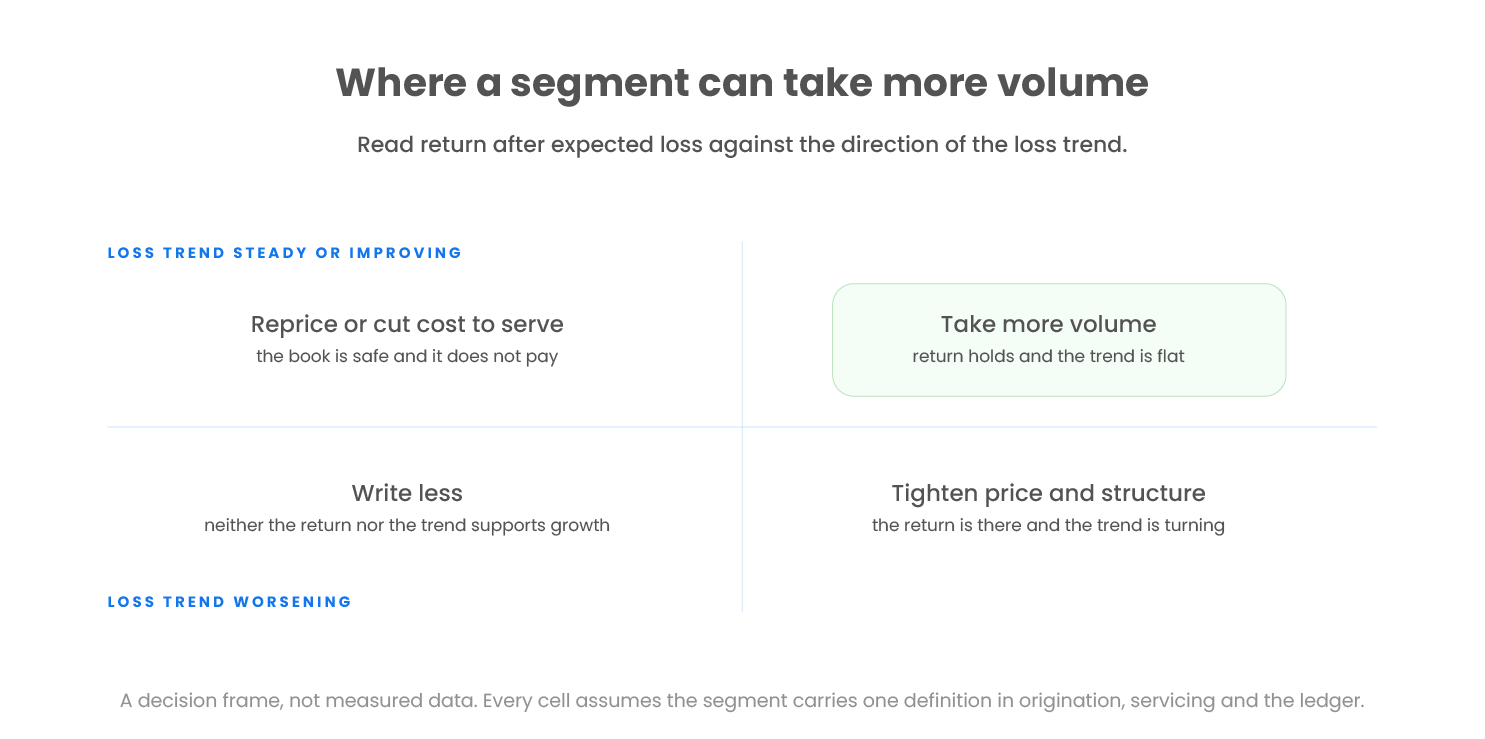
Figure: A segment earns more volume only when its return and its loss trend are read together.
What comparable segments let a leadership team decide
Three questions become answerable once the definitions agree, and all three sit with the executive committee.
Where should the next tranche of capital go? Is a concentration limit describing real exposure, or three systems counting differently? Does the price on a segment still reflect what it now costs in losses?
The arithmetic behind all three is the same. Take the yield a segment earned, subtract the loss expected on its vintage curve, then subtract what it costs to service and collect. What is left is the return that segment produced for the risk it carried. Hold the definition and the observation window steady, or this quarter cannot be read against the last.
Rank the segments on that number and read each against its loss trend.
- A segment whose return holds while its losses stay flat can take more volume.
- A segment whose return holds while its losses rise needs a look at price or structure before it gets more volume.
- A segment whose return falls while its losses rise should get less volume.
That ranking is what risk-adjusted growth means in practice. A delinquency rate on its own shows none of it.
Our blog on credit risk management software makes the same point about a single deal. For how a decision record keeps a grade comparable, see our automotive finance whitepapers.
What this means for lending leaders
- Treat segment definitions as a governance matter, not a reporting one. They decide what the board can see.
- Rank segments on return after expected loss and cost to serve, not on volume.
- Ask what exposure the current pack would be unable to show you, then fix that before buying another dashboard.
Questions about loan portfolio management software
What is loan portfolio management software?
It brings contract, payment and performance data together so a lender can measure the whole book on one basis. For auto lenders it supports concentration limits, vintage analysis and pricing review. Its value depends on whether the source systems agree how a segment is defined.
How do these loan portfolio management platforms integrate with leasing systems?
Through defined interfaces and an agreed data contract, and the definitions inside that contract matter more than the interface. The leasing system, the servicing platform and the ledger have to share keys, dates and status meanings. Without that, the combined report cannot compare like with like.
The fix is a definition, not another dashboard
A pack that only describes the book is not an analysis problem. Three teams are counting the same thing in three different ways, and the board is being asked to allocate capital on the result.
Agree what a segment contains, and the same reporting starts to improve speed, consistency and control across the lending lifecycle. Portfolio visibility stops being a number someone reconciled and becomes a position a credit committee can defend.
Transcend Finance holds origination, contract management and servicing on one core. A segment keeps its definition as a contract moves through our automotive finance software. If you disagree with any of this, we would rather hear it than not.

Modernise your asset finance operations with NETSOL
Related blogs

Blog
What a wholesale lending platform lets you say yes to

Blog
NETSOL is ready for Palm Desert: Transcend Finance to take center stage at ELFA 2026
Blog