Blog
Automotive desking software after a mid-month program change
By NETSOL Technologies , on October 2, 2026
A mid-month program change can quietly break deals your desk has already saved. Here is how the right desking software catches them before your customer does.
Table of Contents
Subscribe to our newsletter
Share this Blog:


On the morning of the 1st, a desk manager opens a list of saved deals. Some were built last week, under a program that no longer exists. Nothing on the screen says which ones.
Every one of those deals is a promise your store made. Automotive desking software either tells the desk which promises can still be kept, or it leaves you to find out the hard way. By then the customer is sitting down, and the number on their phone has stopped being real.
The quote is the promise
A customer who builds a deal online has decided before they arrive. The number is settled in their mind. They are coming in to sign, not to negotiate.
When the desk changes that number, the customer does not hear a pricing correction. They hear that your store quoted something it could not honor. That judgment is made almost immediately and it colors the rest of the visit.
So the question for a dealer principal is not which features a platform has. It is whether your store can keep a promise it made last week.
Programs move faster than anyone plans for
Our blog on the payment your website shows explains why a rebate works like a rule and not a discount. The harder problem starts after that.
Manufacturer programs turn over on their own calendar. A loyalty offer can arrive on the 1st while conquest cash retires the same day, and a subvented rate can expire on one trim while it runs on for the next.
None of that touches the dollar figure sitting inside a saved deal, and that is the trap. The number still looks right, while the people who qualify for it have quietly changed.
The deal does not break loudly. It goes quietly stale.
Two ways to build automotive desking software
A platform can save a payment as an amount, and an amount survives everything, including the program that produced it.
The better ones save the rules instead. When a program moves, the platform tests this customer, this vehicle and this finance product again, then names the deals that changed. The morning starts with a list rather than a surprise.
That difference barely shows in a demonstration. It shows in a bad month.
There is a compliance edge to it too. Regulation Z, the Consumer Financial Protection Bureau rule implementing the Truth in Lending Act, governs how credit is advertised. It says an advertisement stating specific terms "shall state only those terms that actually are or will be arranged or offered by the creditor." Regulation M sets the same test for leases. A payment your desk can no longer write is a term your store is no longer offering.
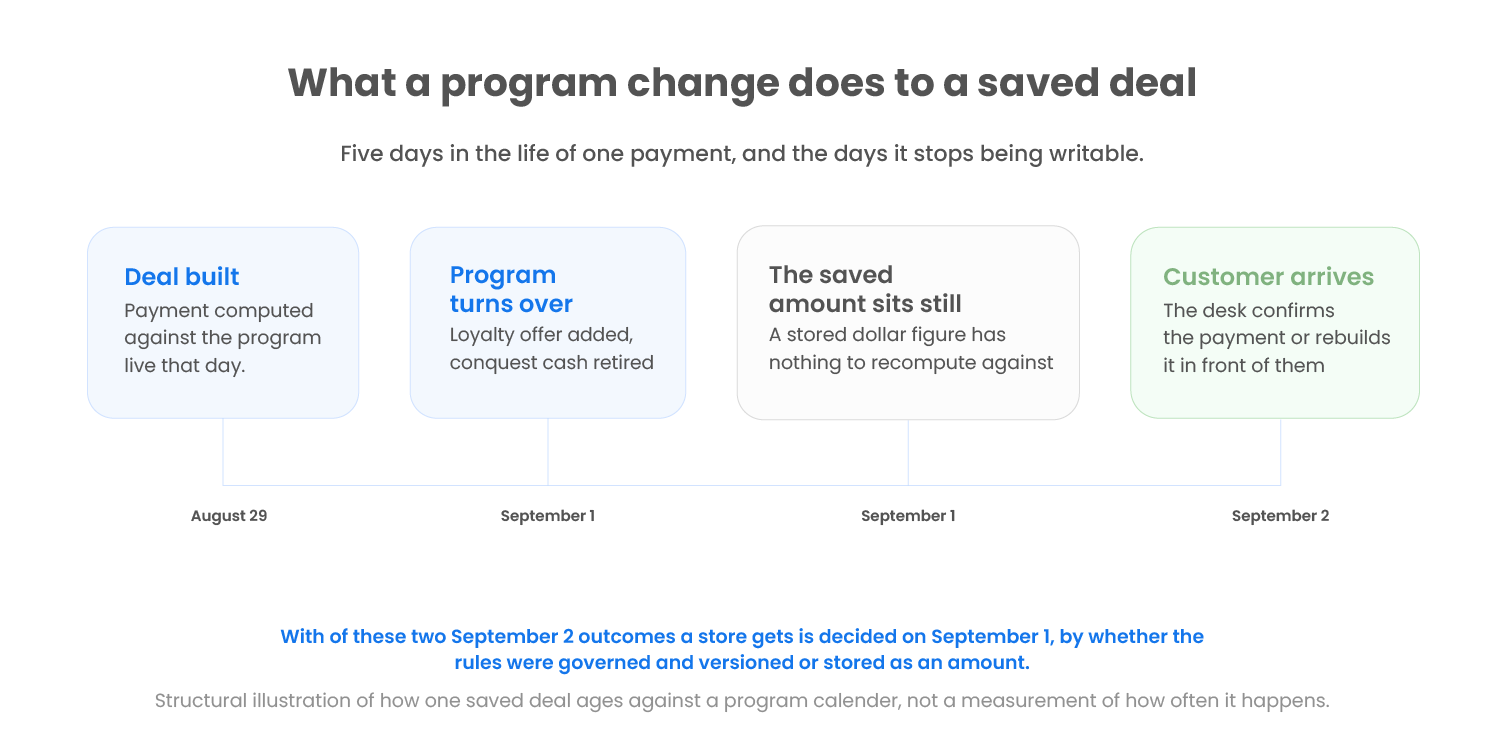
Figure: A program change does not touch a saved payment. It changes whether that payment is still one the desk can write.
Alt text: Timeline of a saved vehicle deal across five days. The deal is built on August 29 against the program live that day. The program turns over on September 1 while the saved dollar amount stays where it was. On September 2 the customer arrives and the desk either confirms the payment or rebuilds it, depending on whether the program rules were governed and versioned or stored as an amount.
An automotive digital retail platform can hold incentive rules, tax logic and lender programs as versioned settings, so one change reaches every saved deal at once. A group running several brands needs that set per brand and per store.
What a stale number costs
A rebuilt deal is rework, and it costs you three times over.
It takes longer to contract, in front of a customer who is watching. Gross leaks, because reopening one line reopens the whole deal rather than the line that moved. Some of those customers then leave to think about it, which is usually where the deal ends.
None of that appears in online lead volume, because lead volume counts the people who started. The number worth watching is how many online deals your desk has to rebuild. That figure is closer to the health of the business than anything on the traffic report. The wider evaluation question, and six tests to put to a vendor, sit in 'The handoff test'.
What this means for dealer principals
- Ask a vendor to show which program version produced a payment saved last month, and time how long the answer takes.
- Treat an overnight program change as work for the desk rather than as something the customer discovers.
- Watch the share of online deals that get rebuilt, because time to contract and gross per deal both follow it.
Frequently asked questions
Do automotive digital retail platforms actually speed up deal closing?
Only when the deal arrives intact. A platform that hands the desk a deal built on current rules removes a rebuild. One that hands over a stale payment adds a renegotiation.
How long should a desking system keep old program versions?
Long enough to explain any payment you honored. Retiring a program should archive its rules rather than overwrite them. A version you deleted is a quote you can no longer account for.
Trust is the thing that has to survive
Accuracy is not something a platform achieves once. Programs will keep moving. What matters is whether the number your customer is holding moves with them.
A store that can answer for its own quotes keeps them credible from the first click to the signature. One that cannot is asking its desk to defend a figure it never produced. That is not a pricing problem. It is a question of who the customer trusts by the time they sit down.
Transcend Retail keeps program, rate and tax rules as versioned settings, so every saved deal knows what built it and what moved underneath. So which version of which program built the last deal you contracted?

If you're in BFSI (Banking, Financial Services, and Insurance), standing still isn't an option.
Related blogs

Blog
What a wholesale lending platform lets you say yes to

Blog
NETSOL is ready for Palm Desert: Transcend Finance to take center stage at ELFA 2026
Blog