Blog
Credit risk monitoring for US auto lenders after origination
By NETSOL Technologies , on September 28, 2026
Regulation V and clearer servicing reports

Table of Contents
Subscribe to our newsletter
Share this Blog:


Your servicing report shows an account as current. The customer has missed a payment but asked for more time. Does the status reflect an approved deferral, a pending request or a reporting error? Before you can assess the risk, you need to understand how the servicer assigned that status.
If a third party services your loans, its system settings shape how early warning signs appear in your reports. Credit risk monitoring after origination depends on understanding those settings and checking reports against your records. Regulation V, which covers consumer credit reporting, adds duties where you furnish information to consumer reporting agencies.
Credit risk monitoring starts with what each status means
A status label summarizes an account, but it does not explain everything that happened. Consider a customer who misses a payment and promises to pay next week. A report might show that promise alongside the past-due balance or in a separate follow-up category. The promise itself does not mean the payment has arrived.
Other servicing events raise similar questions.
- Payment reversal. When a payment is reversed, when does the report show the change?
- Deferral. Has a new payment schedule been approved, or has the customer only requested one?
- Hardship arrangement. Which terms changed, who approved them and where is that decision recorded?
These questions help you interpret early risk indicators and compare reports over time. More past-due accounts could reflect missed payments or a change in reporting rules. An error could also be the cause.
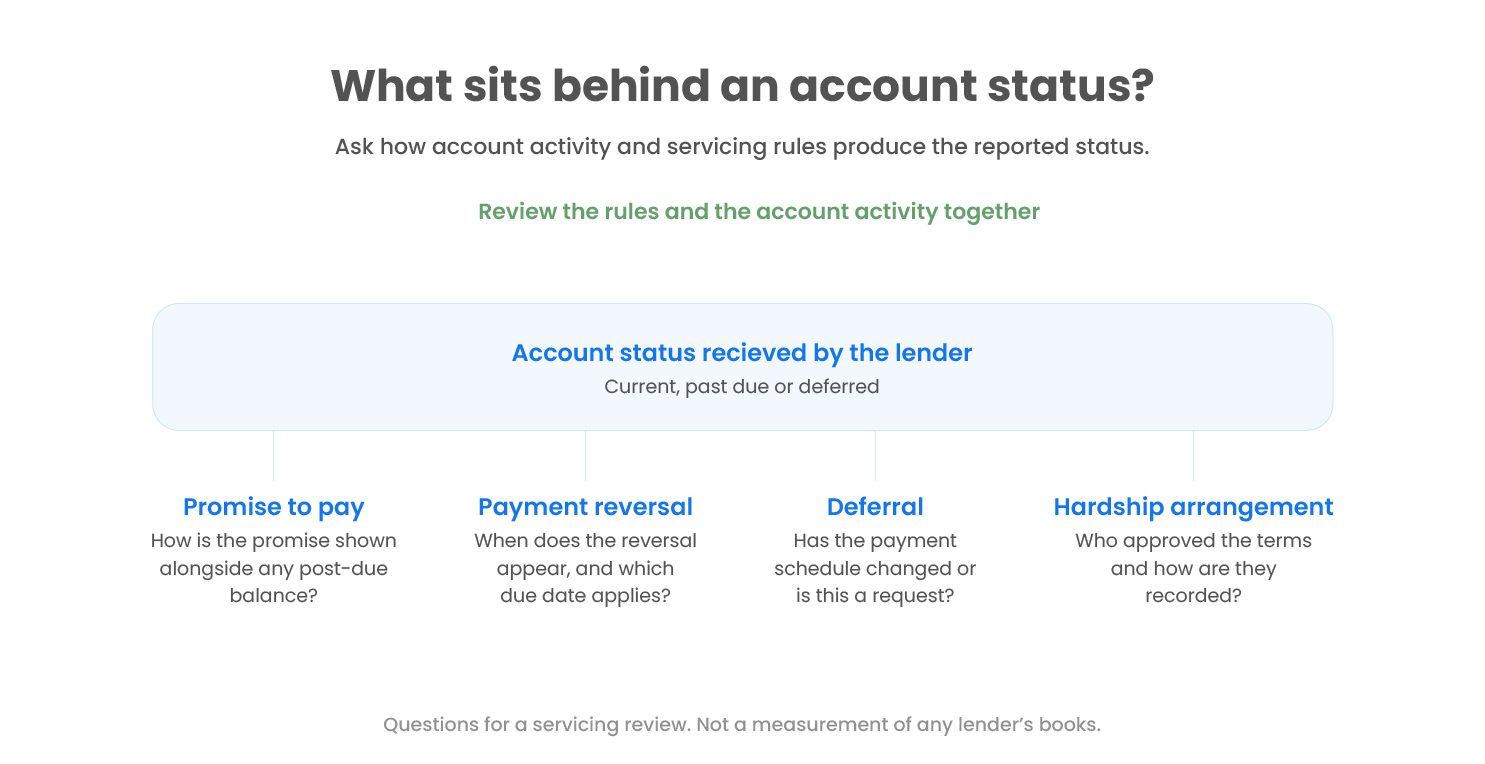
Figure: Check the account activity and servicing rules behind each reported status.
Managing servicing risk starts with clear definitions
A report can arrive on time and contain every required field, yet still be misleading. You and your servicer need to agree on what statuses such as current and past due mean.
Consumer credit reporting brings separate duties. Under the Consumer Financial Protection Bureau's Regulation V definitions, a furnisher provides consumer information for inclusion in a consumer report. Owning the loan does not automatically make you the furnisher.
If you furnish information to consumer reporting agencies, section 1022.42 requires reasonable written policies and procedures to support its accuracy and integrity. Outsourcing servicing does not remove those duties.
Two practical checks can strengthen servicing oversight.
- Keep definitions clear. Document what each key field and status means in the servicing agreement. Require review and approval before those definitions change.
- Check reported results. Regularly compare delinquency reports with payment records and agreed payment schedules, including approved deferrals.
Investigate differences to understand which accounts are affected and why. A mismatch identifies something to resolve; it does not, by itself, measure credit loss. These checks are recommendations. Regulation V does not prescribe this exact process or a monthly schedule.
For example, an account might appear past due in your records but current in the servicer's report. Check whether both teams used the same reporting date. Then check for a payment, reversal or approved deferral that one set of records has not captured. The cause determines the next step. A timing difference may need an agreed cutoff. A wrong status may need to be corrected. Record the cause and confirm how the servicer will prevent it from recurring.
Clear approval rules make servicing changes easier to explain
Once you understand the reported status, check the decision behind any change in payment terms. For a deferral, the servicing agreement should make clear who can approve it and when the lender must decide.
Keep a record of who approved the change, why and which payment dates now apply. The risk team can then see whether the customer missed an agreed payment or received more time to pay. That distinction gives both teams a specific issue to discuss when their reports disagree.
Our article on human overrides in lending decisions explains why they need clear reasons. For wider lending context, see our automotive finance research.
What this means for lending leaders
- Check what key statuses mean before using them to assess risk.
- Check reporting differences against account records and approved payment schedules.
- Keep approval limits clear and retain the reasons for changes.
Questions about monitoring loans after origination
What is credit risk monitoring after origination?
Credit risk monitoring after origination tracks payment and account activity for signs of financial difficulty. Missed payments, reversals and repeated broken promises to pay can inform that assessment. Understanding how the servicer records these events helps lenders interpret the reported results.
How do you monitor loans serviced by a third party?
Agree on key reporting definitions and obtain the records needed to check the results. The agreement should set clear approval limits for payment changes. These controls need review when servicing policies or systems change.
Start with one account in your next servicing review
Choose an account whose status needs explaining. Ask the servicer to show the payment history, applicable schedule and any approved changes. Your team can compare those records with the report it received. Resolving any differences gives both teams a common basis for future reviews. This improves consistency and control across the lending lifecycle. Less time spent explaining reports also supports decision speed.
Transcend Finance, our automotive finance platform, includes contract management, servicing and collections modules. Which part of your servicing process would be most useful to discuss with our team?

Modernise your asset finance operations with NETSOL
Related blogs

Blog
What a wholesale lending platform lets you say yes to

Blog
NETSOL is ready for Palm Desert: Transcend Finance to take center stage at ELFA 2026
Blog