Blog
Wholesale finance implementation that lasts beyond go-live
By NETSOL Technologies , on September 22, 2026
What separates a vendor from a long-term wholesale finance partner, and how to tell before you are relying on it.

Table of Contents
Subscribe to our newsletter
Share this Blog:


A wholesale finance go-live has a war room, a countdown and a vendor team on site until every dealer can draw against their line. 18 months later the war room is gone. The launch specialists have moved on. The same book still needs curtailments correct at 5:00 pm on a Friday.
Proven wholesale finance implementation expertise is not what gets a vendor through go-live. It is what remains once the launch team leaves. That means a named account team that survives a staff change and an escalation path a dealer manager can use. It also means a platform built to absorb the next rule change without a second migration.
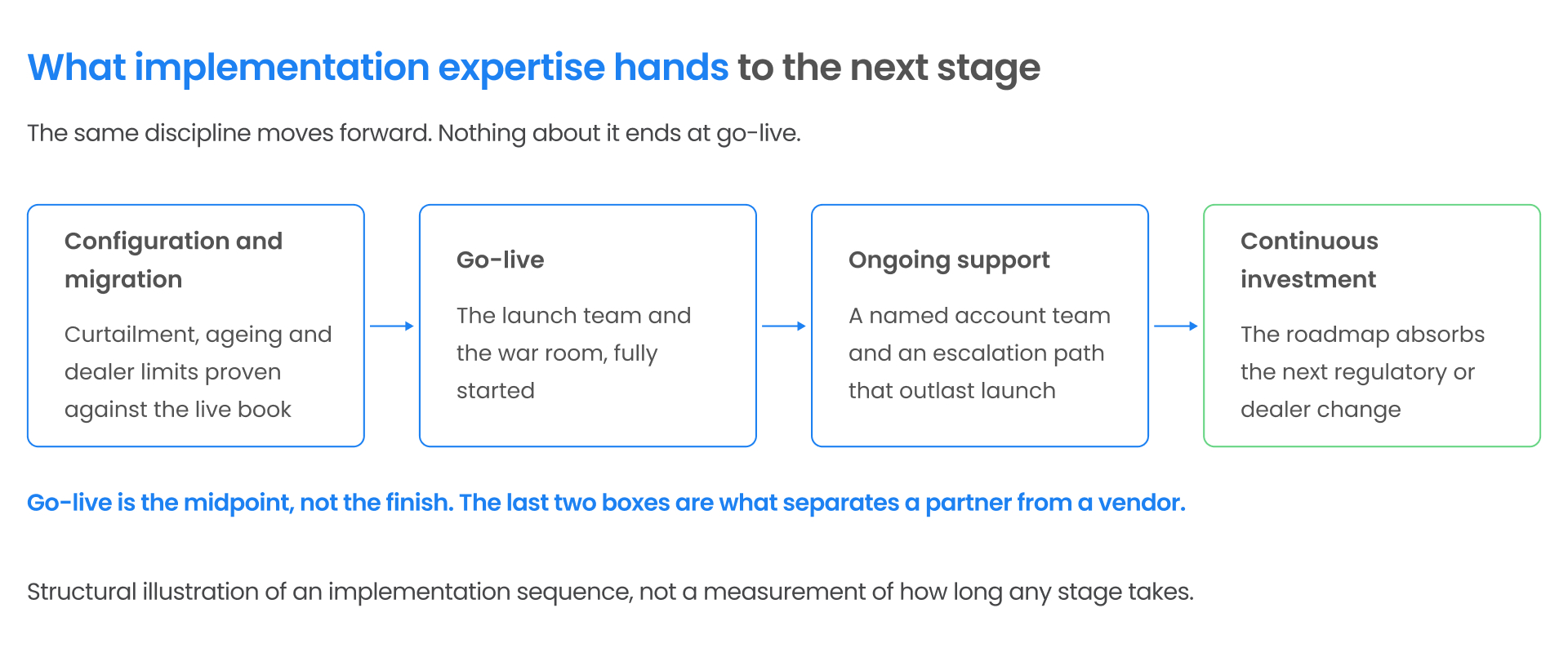
Figure one shows how implementation expertise carries into go-live, support and roadmap investment. The last two stages are what separate a partner from a vendor.
Wholesale finance implementation expertise starts before go-live, not at it
A demonstration shows the software on a clean data set. A live floorplan book is different. Curtailment (the scheduled paydown on a floorplan unit), ageing calculations and dealer limits must survive the move into production without a gap an auditor can find. That is where implementation expertise is tested, before a leader thinks about support.
NETSOL's own migration record moved nearly 50,000 legacy finance contracts off a COBOL-era system with zero major disruption (NETSOL Technologies, 2026). Planning that cutover and testing the fallback is not a one-off project skill. It is the discipline a lender needs on every release afterwards, because a floorplan book never stops changing shape.
That same discipline is tested again under a planned software release.
Ongoing support decides whether the relationship survives a bad week
Implementation is visible and usually fully staffed, but business as usual is less forgiving. The platform quietly holds together dealer funding, disbursement and unit release whilst a smaller team manages what a demonstration never showed. When a floor check turns up a problem, the question is not whether the platform can be set up to handle it. It is whether a named person, not a ticket queue, picks it up.
Not every wholesale lender sits inside the resilience rules the Financial Conduct Authority (FCA) sets. For firms within scope, FCA guidance says a provider's failure to remain within impact tolerance on an important business service "is your responsibility" (Financial Conduct Authority, 2024). It also expects relationships with third parties to be managed actively. Either way, a vendor with a support rota, a named account team and a documented escalation path gives a lender something to manage. A vendor without one leaves the lender managing the gap alone.
Continuous platform investment is what makes the relationship worth renewing
A platform bought once and left alone becomes the next migration project. The alternative is a vendor whose roadmap keeps the wholesale finance module current against new dealer needs and reporting rules. The module stays current through the business rule engine, set up rather than custom-coded. That is what lets a lender adopt a change without re-platforming. It is the clearest sign of investment in the relationship, not the sale.
None of this shows up in a sales cycle, which is why the decision needs a second document alongside the feature matrix. Our wholesale finance guides set out the questions worth asking before signing an agreement. Among them, “The demo lasts an hour. The vendor stays for years.” outline the questions worth asking before signing an agreement. These questions help assess what matters in production, including the named account team, escalation path and product roadmap.
What this means for wholesale finance leaders
- Check implementation evidence like the feature list. Ask for an anonymised cutover or reconciliation example, not a client logo.
- Review who owns an urgent incident by name, not by process diagram, before the sales-cycle account team moves on.
- Treat roadmap investment as a renewal question. Check whether the platform absorbed a real rule or dealer change in the past year, not just at launch.
Questions wholesale finance leaders ask about implementation expertise
What does proven wholesale finance implementation expertise actually look like?
Evidence beats assurance. Look for a documented migration and a named support team that survives a staff change. Add a roadmap that has absorbed a real rule change in the past year without a second implementation project.
How do you assess a vendor's post-go-live support before signing?
Ask for the support rota, the named escalation path and an anonymised example of how a wholesale control problem was found and fixed. A vague answer to any of the three is itself the evidence.
The go-live date is the start of the relationship, not the proof of it
A demonstration and a feature matrix test only the software. The vendor is tested afterwards, in the release that lands mid-cycle, the unplanned incident and the year a new reporting rule reaches the roadmap. Implementation expertise that lasts is the same discipline on both sides of go-live, not a skill retired once the contract is signed.
Transcend Finance's wholesale finance module runs on the same configurable design behind that migration. That is why a rule or dealer change reaches production without a rebuild. Tell us what your version of this looks like.

Modernise your asset finance operations with NETSOL
Related blogs

Blog
What a wholesale lending platform lets you say yes to

Blog
NETSOL is ready for Palm Desert: Transcend Finance to take center stage at ELFA 2026
Blog