Blog
UK automotive lending software and transformation risk
By NETSOL Technologies , on September 29, 2026
Why the choices made before configuration starts do more to set programme risk than the platform does
Table of Contents
Subscribe to our newsletter
Share this Blog:


A transformation programme rarely goes wrong where everyone is watching. It goes wrong in a requirement nobody queried. It goes wrong in a running process carried across because retiring it was never on the agenda. By the time those surface in testing, they are costly to undo.
A demonstration tests the software. A transformation programme tests every choice made before the software was set up. Institutional knowledge is what a vendor brings to those choices. In automotive lending software it shows up as pitfalls named early, and as requirements sent back before anyone starts building.
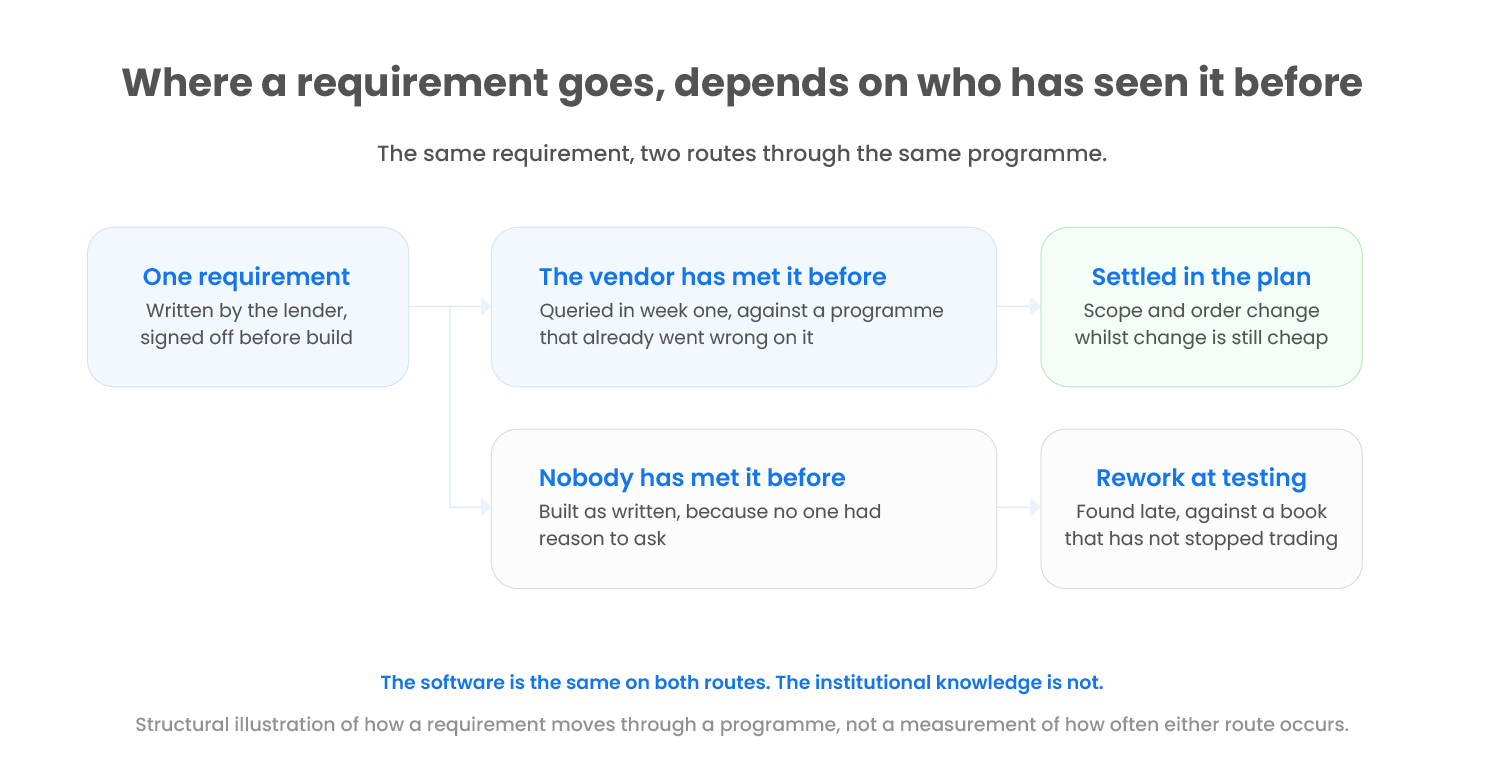
Figure 01 shows one requirement taking two routes through a programme. What separates them is whether anyone had watched it fail before.
A live book does not pause whilst the platform is replaced
Most transformation risk in motor finance is not technical. It is the cost of finding something late whilst the business keeps trading. Finance and Leasing Association figures record 171,469 new consumer car finance agreements at point of sale in July 2026. A lender mid-programme still books and services that flow (Finance and Leasing Association, 2026).
So the order of work matters more than the feature list. A choice put off is a choice the live book forces later. It tends to return at the point where reversing it costs most.
Every hard-won lesson belongs to someone else's programme first
A team implementing once meets each pitfall as news. A team that has implemented across many markets meets the same pitfall as a lesson someone else has already paid for. The gap is not effort. It is whether the question gets asked in week one or found at user acceptance testing.
NETSOL's programme for a global automotive captive shows the mechanism. Before country rollout, the work ran through a configured model office in Singapore. Pre-gap workshops covered Korea for retail credit application processing and Australia for wholesale finance (NETSOL Technologies, n.d.). Each market's gaps were found whilst they were still plan choices.
Umar Qadri, NETSOL's Deputy Global Head of Sales, said, “The model office gave the team a controlled environment to pressure-test assumptions before they became country-level delivery risks.”
That is advisory work rather than set-up work. The platform was where the questions got asked, and the answers changed the plan.
What to test in an automotive lending software vendor
Ask for a requirement an earlier client wanted and the vendor argued against. A team with real delivery experience will have one and will say what it costs that client to insist on. A team without one has never pushed back, or has never been asked to.
Then ask who sets the order of work. Guidance on what to do first, what to defer and what to stop doing is the part no feature matrix covers. It is also where a transformation is built to succeed or quietly set up to fail. Our automotive finance guides and the eBook in that set work through the questions worth asking before a programme is scoped.
What this means for UK lending leaders
Check the pitfall record before the success story. A vendor who cannot say what usually goes wrong has not been close enough to a programme that did.
Review the order of work before the feature list. Whoever decides what happens first is deciding most of your risk.
Treat advisory depth as a selection test. Set-up skill is common, and knowing which requirement to challenge is not.
Questions UK lenders ask about implementation risk
What should a UK lender check before buying automotive lending software?
The implementation record matters as much as the feature list. A useful test is to ask which requirement the vendor argued against on an earlier programme. The answer shows whether the team has enough delivery history to push back on yours.
How is transformation risk managed in automotive finance and leasing?
Mostly by finding choices early. Risk sits in the scope, order and data choices made before set-up begins. It falls when an experienced team raises those as questions rather than meeting them in testing.
Experience is only useful when it changes your plan
Four decades of delivery experience is a claim about the past. What a lender buys is narrower. It is the set of questions a team asks on day one, because it has watched those questions go wrong elsewhere. Global reach shows the range of programmes behind that instinct. That is why global and UK delivery experience is worth testing during selection.
Transcend Finance holds product rules and approval routes in the business rule engine rather than in forked code. That is what lets a choice change mid-programme without a rebuild. It is the mechanical half of an automotive finance platform built for your success. The advisory half decides what you set up at all. We spend most weeks inside this problem with lenders who have already tried it once, and we would welcome the chance to help you get it right this time. With more than four decades of experience supporting auto and equipment finance providers worldwide, NETSOL brings the platform and the practical know-how to turn that second attempt into a lasting success.

Modernise your asset finance operations with NETSOL
Related blogs
Blog
Changing a credit rule in auto lending software

Blog
Equipment finance system migration is a data problem first

Blog