Blog
Automotive retail solutions are only as good as the handoff
By NETSOL Technologies , on November 4, 2026
How to check whether an online deal reaches the systems your team uses

Table of Contents
Subscribe to our newsletter
Share this Blog:


At an online buying demo, an operations director asks where the deal appears in the dealer management system and who enters a missing detail. The answer shows how much work the tool leaves for the dealership.
Judge automotive retail solutions by the information they pass into your existing systems. A usable deal keeps vehicle, payment, trade and finance details in fields the next system can use. Staff can then continue the sale instead of entering those details again. Ask which details reach your DMS and CRM, and who fixes a gap.
Automotive retail solutions must pass on a usable deal
The retail front end is the buying screen shoppers and sales staff use. Behind it are the dealer management system, CRM and other services. A structured, finance-ready deal means the next system receives the details it needs in usable fields. Staff can pick up the sale there without rebuilding it.
Suppose a trade value is entered online but does not appear in the dealer management system. A staff member must find and re-enter it. That slows contract preparation and takes time from other finance work. Our article on what the desk sees at check-in covers what a deal may already hold when a customer arrives.
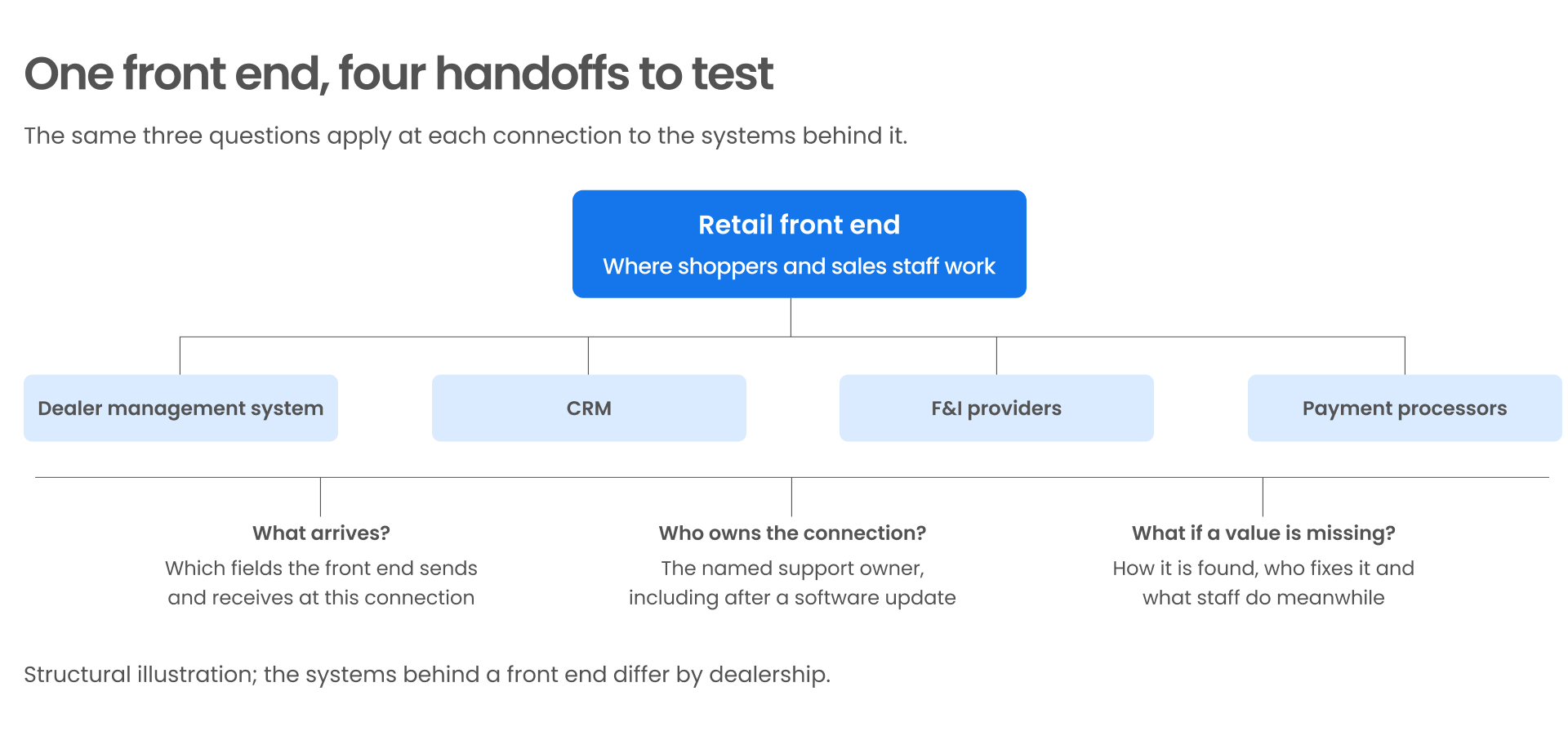
Figure: The useful test is what the retail front end passes into the systems behind it.
Know where customer data goes before you choose
Customer information travels with the deal, so ask where it goes. The Federal Trade Commission's Safeguards Rule applies to some dealerships. If yours is covered, section 314.4(f) requires you to oversee service providers with access to customer information. It calls for careful selection, safeguards in contracts and periodic checks. Counsel can confirm whether the rule applies to your dealership.
Ask for a deal trace before you sign
Ask the vendor to show a deal moving from the online front end into your DMS and CRM. Then trace a recent deal from your own store. Where did staff check, correct or re-enter information? Ask which fields move, how an error is reported and who fixes it after an update. The answers show whether the issue is a connection, a process step or a manual check you want to keep. Our dealer group guides offer more questions for these handoffs.
What this means for dealer groups
- Ask the vendor to show where a deal appears in your DMS and CRM.
- Check a recent deal for details staff had to enter again.
- Flag providers with access to customer information and check how you oversee them.
Questions about retail front ends
What should a retail front end pass to a dealer management system?
It should pass the vehicle, payment, trade, credit and contract details needed for the next step. Ask which fields move in each direction, who maintains the connection and how staff find and fix a missing value.
What does a structured deal look like when it arrives?
A structured deal puts vehicle, payment, trade, credit and contract details into fields the receiving system can use. Staff can review and continue it without typing those details again. Ask the vendor to show an example in your dealer management system.
Ask to see the handoff before you see the screens
A demo shows what shoppers see from their first click; a deal trace shows what your team receives. For a general manager and F&I director, missing details create work before the contract is signed. When margins are tight, repeated entry wastes time that could move another deal forward. Measure handoffs alongside the time to contract and the number of deals the finance office completes.
Transcend Retail draws on NETSOL's decades of automotive finance and leasing technology experience. Its deal execution platform gives shoppers and sales staff a front end built to pass structured deal details to dealership systems. This can reduce repeated data entry. Tell us which handoff in your deal path takes the most staff time.

One platform from first click to signed deal.
Related blogs

Blog
Why equipment lending software must work after funding

Blog
Automotive digital retailing solutions prepare the desk

Blog