Blog
Dealers and OEMs shouldn’t have to call to see a deal
By NETSOL Technologies , on November 20, 2026
In a vendor finance program, an equipment maker or dealer, the vendor, offers its customers financing from a lender partner. The vendor has the customer and the lender has the credit decision, so the vendor waits on the lender to learn where a deal stands. Each time the vendor has to ask, the sale slows down.
Table of Contents
Subscribe to our newsletter
Share this Blog:


A vendor finance program is only as strong as the vendor's view of each deal. The vendor should be able to send a deal, see where it stands and supply what is missing without calling the lender. For an equipment lender, that means a portal the vendor can use on the web and on a phone.
Why does the vendor's view of a deal matter?
Financing is part of the sale. The Equipment Leasing & Finance Association surveyed end-users for its Industry Horizon Report. Of those who acquired equipment or software in 2025, 87% used at least one form of financing to do so (Equipment Leasing & Finance Association, 2026).
Customers also want to see where their application stands. The survey asked which digital features would have the greatest positive impact on the financing experience. Real-time tracking of application status was on the list at 44% (Equipment Leasing & Finance Association, 2026).
In a vendor program, the customer deals with the vendor, so the vendor is the one who asks the lender where the deal stands. When the lender answers by email or phone, each question is a wait for the vendor and another call for the program team. Our blog on equipment finance products explains how vendor finance differs from a loan or a lease.
What should a vendor see on every deal?
A vendor has one question at each step of a deal. The vendor needs to know that the application arrived and who has it. Next comes the decision, whether it is approved, declined or on hold. Then it needs to know what is signed and what is still open. Last, it needs to know whether the deal funded.
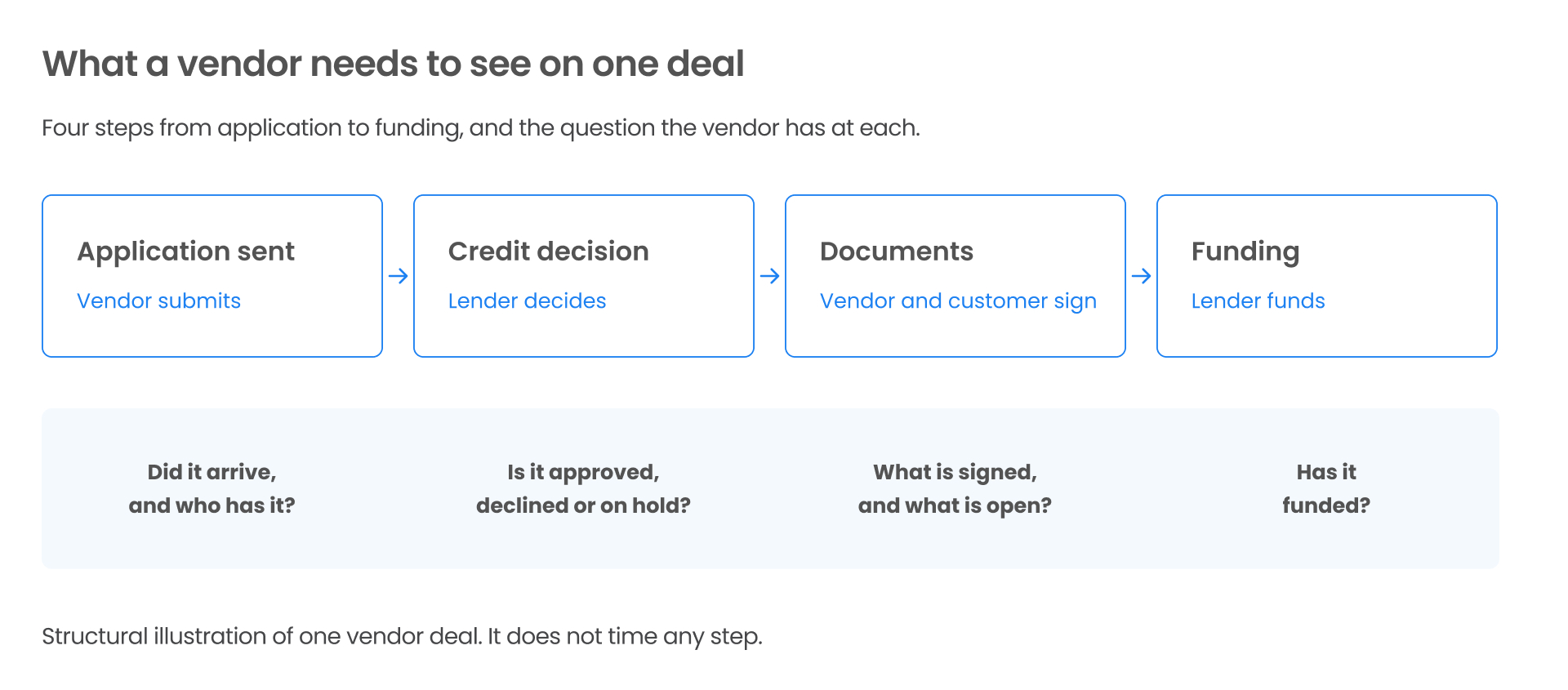
Figure: At each step the vendor has one question, and a view of the deal answers it without a call.
When both sides see the same deal, a vendor can supply a missing document and the analyst can see it arrive. Customers want this on the documents side too. Online document upload and verification was on the same survey list at 43% (Equipment Leasing & Finance Association, 2026).
Which channels should a vendor finance program offer?
The ones the vendor already works in. A vendor's office uses a browser, and its salesperson at the customer's site uses a phone. A portal that works on both lets either one check a deal or send one without calling anyone. Email notifications at each step can cover the time in between.
We cover how vendor, customer and operations channels fit together in our equipment finance whitepapers.
What this means for equipment finance leaders
- Give vendors one place to send a deal and see where it stands.
- Let vendors see what is missing on a deal, so they can supply it without a call.
- Offer the channels vendors already work in, on the web and on a phone.
Questions about vendor finance programs
How does a vendor finance program work?
An equipment maker or dealer offers its customers financing from a lender partner at the time of sale. The vendor brings the customer and submits the deal. The lender decides on the credit and funds it.
What should a vendor portal show?
It should show whether the application arrived and whether it is approved, declined or on hold. It should also show what is signed, what is still open and whether the deal has funded.
The vendor should be able to answer its own question
The choice is not between a portal and a phone call. It is who answers the vendor's first question, which is where the deal stands. If your staff answer it, every new deal adds calls for them to take. If the vendor can answer it, your staff are left with the deals that need a person. That choice belongs to whoever owns the program's volume and its cost to serve.
Transcend Finance, our equipment finance platform, gives vendors and dealers a web point of sale that is also available on mobile devices, so they can capture and manage customer applications. Count how many calls your team took last week from vendors who only wanted to know where a deal stood.

One platform from first click to signed deal.
Related blogs
Blog
Legacy system modernization does not need a full replacement

Blog
Should every US dealership feature hybrids as sales rise?

Blog