Blog
Why equipment lending software must work after funding
By NETSOL Technologies , on October 30, 2026
A practical test for servicing, contract changes and lease returns

Table of Contents
Subscribe to our newsletter
Share this Blog:


A software demonstration often ends when an equipment agreement is funded. For the lender, that is the start of the longer job. Payments have to be collected, terms may change and some leased assets will come back. A good demonstration keeps going past approval.
Equipment lending software should be judged on what happens after funding. A missed payment, an early payoff and, for leases, the maturity decision each need staff to act. None should mean rebuilding the agreement. A demonstration that stops at the approval screen shows none of them.
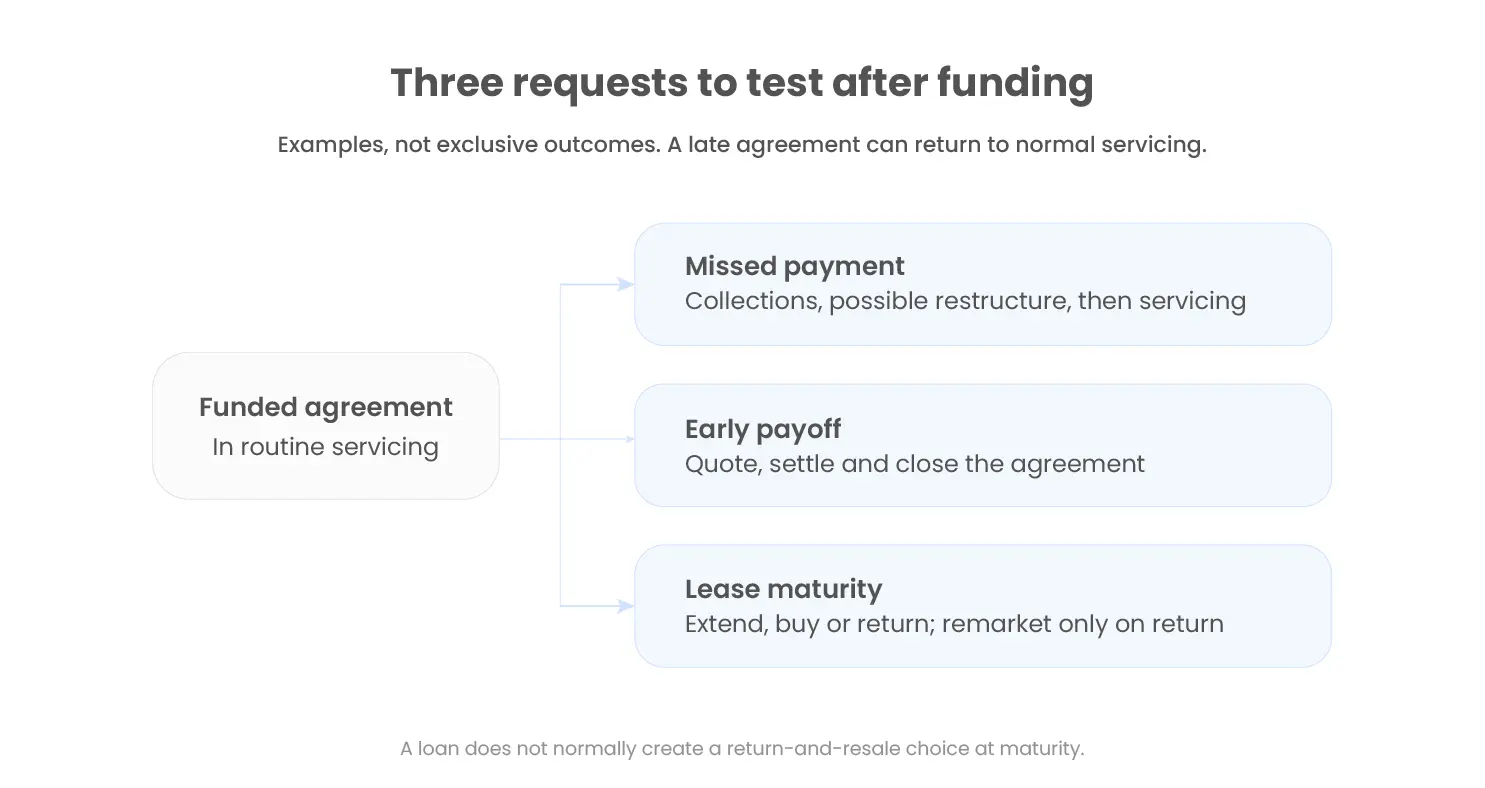
Figure: Three post-funding requests to test, and the remarketing step that follows only when a leased asset comes back.
Equipment lending software should show a missed payment
Start with a funded agreement and its payment schedule. Ask the vendor to show what staff see when a payment is missed and who works the account. Then ask what happens if the lender agrees to move a due date or extend the term. Can staff continue servicing the same agreement under the revised schedule?
Origination sets this up. Servicing, collections and remarketing later work from the terms and asset details captured at approval.
A late agreement may be brought up to date or restructured and then continue for years. Servicing needs to know which terms now apply, and collections needs a clear record of what was agreed.
The Equipment Leasing and Finance Association reported that the overall delinquency rate in its August 2026 CapEx Finance Index held at 1.8% (ELFA CapEx Finance Index, 2026). That member-survey rate describes credit performance, not the effort of working a late agreement. Even a low rate leaves some agreements late, and a path used rarely still has to work. A clean demonstration will not show it unless the buyer asks.
Our blog on equipment payment structures explains why the same missed payment can have different implications across products.
Early payoff and lease maturity require different work
An early payoff starts when a customer asks to close the agreement before its scheduled end. The team needs a quote, a clear balance and a way to complete the close. It can happen without a missed payment, so test it separately from collections.
A lease reaching maturity brings another decision. Depending on its terms, the customer may extend the lease, buy the equipment or return it. A loan does not normally create that return-and-resale choice. If leased equipment comes back, staff must record its condition and location before deciding how to sell or place it again. Ask the vendor to show what happens to the asset details captured at approval.
These are different requests a lender may need to handle, sometimes on the same agreement, not competing endings. The software should make each request clear to the next team without forcing staff to reconstruct the contract from emails.
Make the vendor show the work across your book
Bring examples from the loans and leases you actually hold. Ask the vendor to show a missed payment on one, a change in terms on another and a returned leased asset on a third. At each step, identify who acts next and what they receive. Note where staff re-enter details, export a file or work outside the system. Leaders can track two things. One is how long a change takes to reach the team that must act on it. The other is how many steps happen outside the platform.
The question is whether one configurable platform can handle different assets, products and processes without forcing them through the same steps.
For a fuller walk-through of one lease, our US equipment finance guide follows the agreement through maturity.
What equipment finance leaders should check
- Show a missed payment and an agreed restructure on a funded agreement.
- Test early payoff separately from collections, and returns only where the lease permits them.
- Measure the steps staff complete outside the platform and how long a change takes to reach the team that acts.
Questions about equipment lending software after funding
What should an equipment lending software demo show after funding?
It should show routine servicing and what changes when a payment is missed or terms are revised. Ask for an early payoff example too. If your book includes leases, follow a maturity decision and a returned asset into remarketing where the agreement calls for it.
Does every equipment finance agreement end in remarketing?
No. Equipment loan software can close an agreement once it is repaid, while a lease may be extended, purchased or returned. Remarketing becomes relevant when an asset comes back, including after a lease return or recovery.
The real test begins when the agreement changes
Funding shows that a platform can start an agreement. The test is whether the lender can manage it when something changes. A missed payment, an early payoff and a lease return call for different actions, yet each depends on terms captured earlier. A demonstration should show those handoffs before the lender has to live with them.
NETSOL Technologies has four decades of experience in finance and leasing technology. Transcend Finance brings contract management, servicing, collections, asset management and remarketing into a single, integrated platform for equipment finance. The useful next conversation starts with the step your team still handles outside the system. Tell us where that happens in your book.

Modernise your asset finance operations with NETSOL
Related blogs

Blog
Automotive digital retailing solutions prepare the desk

Blog
The impact of manual rework on equipment leasing operations

Blog