Blog
Equipment finance system migration is a data problem first
By NETSOL Technologies Inc. , on October 16, 2026
What de-risks a platform change for an equipment lender in the Asia Pacific region
Table of Contents
Subscribe to our newsletter
Share this Blog:


In an older equipment finance system, one contract line can stand for three machines and a payment plan. The new platform expects each machine on its own record. Nobody sees the gap on migration day. It shows up later, in servicing and reporting.
Replacing an equipment finance system is mostly a data problem. The software is the smaller risk. The larger one is whether each contract keeps its meaning when it moves. That is decided before cutover, in how the data is classified, staged and reconciled.
The risk sits in what the old records mean
A global equipment manufacturer-backed finance provider had approximately 48,000 contracts to move. They sat in a legacy system built on Common Business-Oriented Language (COBOL). Around 12,000 were live and 36,000 were not (NETSOL case study, 2026).
The hard part was not volume. The old system held asset information in a consolidated structure, so assets could not be lifted out one at a time. They had to be separated and classified first. Multi-asset contracts, direct debit plans and business-specific contract structures all needed handling on the way (NETSOL Technologies, 2026).
That is the equipment finance form of the problem. A lender with several asset classes carries several ways of describing an asset. An older system may have folded them into one. The data moves cleanly and the meaning does not. Our blog on running several asset classes on one platform covers where those differences live once the data has arrived.
Live contracts were only around a quarter of the portfolio. The case study is clear that historical contract data carried risk as well. The 36,000 non-live contracts were never a footnote.
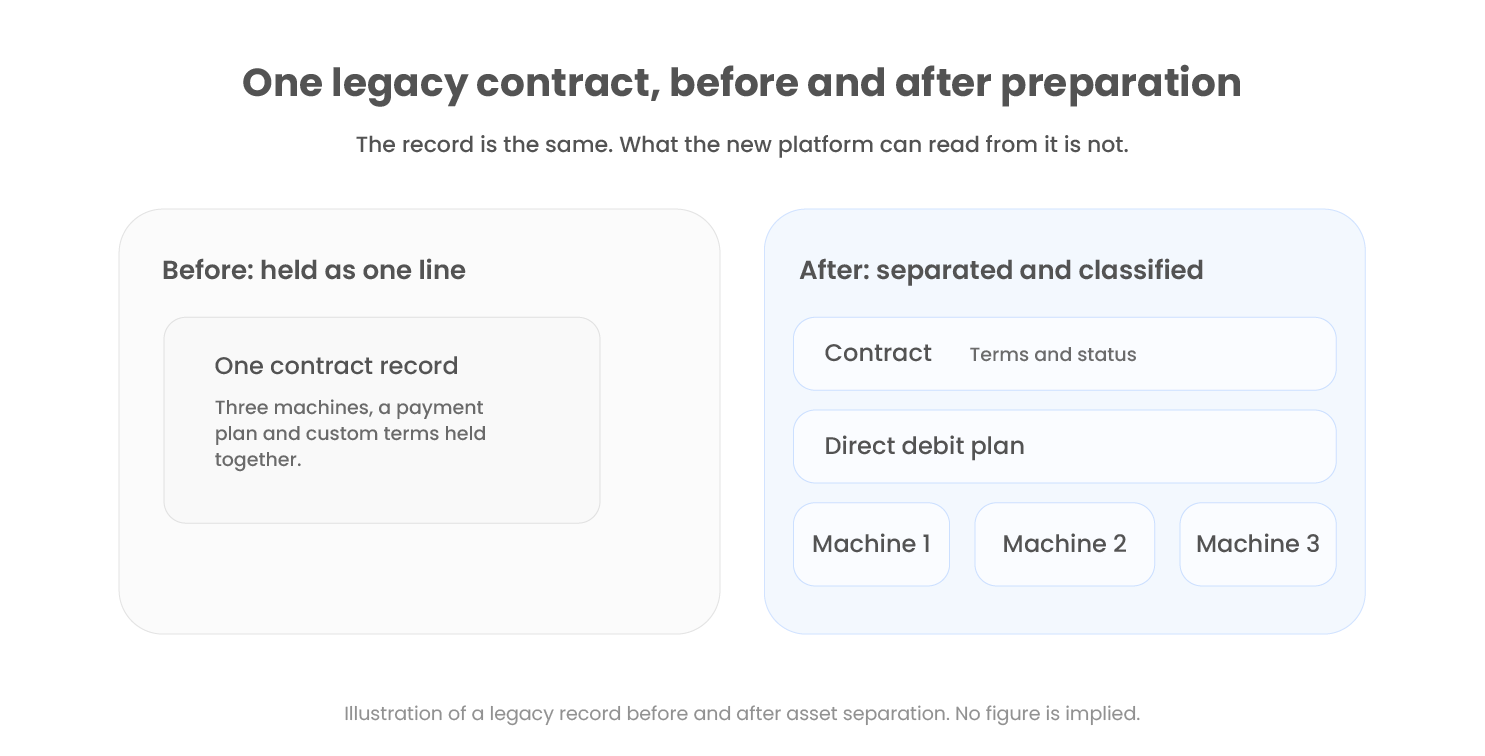
Figure: The same contract before and after preparation. Separation is what lets a new platform read each machine.
Control has to come before cutover
Because the data could not simply be lifted across, the source was first converted from COBOL into SQL Server. It was then loaded into a staging database, which the case study calls a controlled migration layer. Converted data was reviewed, validated, transformed and reconciled there before it was pushed forward for migration (NETSOL Technologies, 2026).
The effort was substantial, at approximately 430 person-days. The programme finished on the agreed timeline, and the case study reports no major delivery escalations. Preparation did the work that a straight extract and load would have left to the new platform.
A plan should answer three things before cutover day
NETSOL brings four decades of global experience to this work and supports customers in more than 30 countries. What that experience mostly adds to a migration is a method for asking the right questions early. A good plan says how assets will be separated and classified. A platform can only report on what it can tell apart. It says where converted data is checked against the source, ideally before the new platform sees any of it. And it says who signs off reconciliation and what counts as ready. A date without a readiness test is only a date.
For lenders APRA regulates in Australia, the stakes have a regulatory edge. APRA's CPS 230 lists technology risk, data risk and change management risk among the operational risks an entity must manage (Australian Prudential Regulation Authority, 2025). A platform migration touches all three.
What this means for asset finance leaders
- Write down what each legacy field means before deciding where it moves.
- Treat non-live contracts as part of the plan, not an afterthought.
- Check converted data against the source before the new platform sees it.
Our asset finance whitepapers set out the wider picture for lenders modernising complex operations.
Questions about equipment finance system migration
Why do equipment finance system migrations carry so much risk?
Contract data underpins servicing, reporting and portfolio control. An older system may hold it in structures a new platform cannot read directly. Moving it safely means preparing it first, not only copying it.
What is a staging database in a migration?
A controlled layer between the old and new systems. Converted data is loaded there to be reviewed, validated, transformed and reconciled, so differences surface before the new platform is affected.
Migration risk is retired before cutover, not on the day
The case for modernising an equipment finance system is usually clear. What decides whether it goes well is quieter work on what the old records mean. Get the asset structure, the staging and the readiness test right and the cutover becomes the least eventful part. That call sits with whoever owns portfolio control, since it is their reporting the data has to keep supporting.
Transcend Finance gives migrated data somewhere to land. Each asset is held as its own record under a contract, and workflow is configured by asset class on one configurable platform. That is how our equipment finance system carries complex operations after a move. Which contract in your oldest system would you least want to see move as a single line?

Modernise your asset finance operations with NETSOL
Related blogs
Blog
An automotive digital retail platform has to finish the deal
Blog
Asset finance management software and the average that is not your book
Blog