Blog
Asset finance software has to hold four capex cycles at once
By NETSOL Technologies , on July 30, 2026
Learn how configurable asset finance software helps lenders support diverse asset classes, reduce customization, and scale multi-vertical lending efficiently.
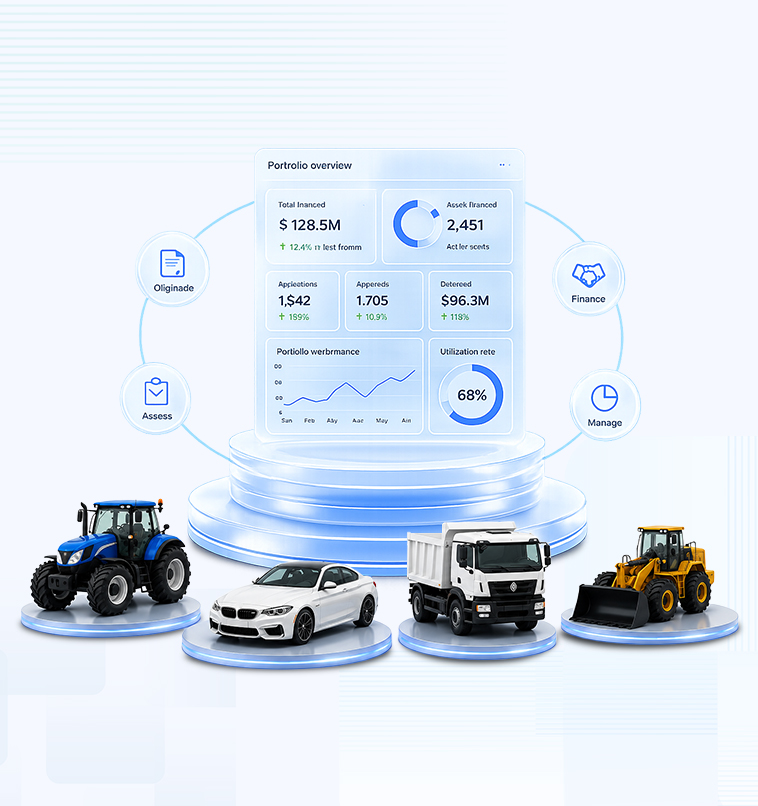
Table of Contents
Subscribe to our newsletter
Share this Blog:


One Australian book can hold a data centre server rack, a longwall mining shear and a header. Same lender, same credit committee, same month-end close. Three assets whose residual curves, obsolescence risk and borrower cash flow have almost nothing in common. Most asset finance software is designed around one and forces the rest into its shape.
The answer is configuration, not separate systems. In configurable asset finance software, residual curves, payment structures, collateral monitoring and end-of-term options sit as parameters on one core, so a lender keeps specialist accuracy in every vertical without running a separate operating model for each one.
One vertical grew 27 times faster than another last quarter
Australian private new capital expenditure rose 6.5% in the March quarter of 2026 and 14.6% through the year, seasonally adjusted. Equipment, plant and machinery rose 18.1% in the quarter and 31.0% through the year (Australian Bureau of Statistics private new capital expenditure, March 2026). Useful for a board paper. Useless for a portfolio decision.
Because underneath those numbers, the verticals barely resemble each other. Information media and telecommunications equipment, the category carrying data centre and network hardware, rose 196.1% in the quarter. Mining equipment and machinery rose 7.2% over the same three months (ABS, 2026). Both are seasonally adjusted chain volume measures, so neither is a price effect.
Two verticals in one book, one growing roughly 27 times faster than the other in a single quarter. And the assets behave nothing alike. A server rack is obsolescence-led, refreshed on a technology cycle, installed into a facility and effectively immovable. A longwall shear runs for decades on a commodity cycle, is registrable on the Personal Property Securities Register (PPSR) and holds residual value in a deep global secondary market.
Price them from the same template and you misread both. Write the aggregate 18.1% into your growth assumptions and you have modelled neither vertical.
Asset finance software should carry vertical difference as configuration
Four things genuinely differ by asset class, and all four are parameters rather than products.
- Residual and end-of-term. Mining plant has a long life and a deep secondary market, so end-of-term is a resale decision. Data centre equipment is obsolescence-led, so end-of-term is a refresh decision. Same clause in the contract, opposite economics.
- Payment structure. Seasonal and skip payments follow harvest cycles in agriculture. Progress payments follow construction and fit-out schedules. Neither belongs hard-coded.
- Collateral monitoring. A serialised machine registered on the PPSR can be located and recovered. Equipment racked inside a colocation facility, in practice, cannot. Monitoring cadence and loss assumptions should differ accordingly.
- Documentation. Requirements differ by asset class and by market. Australian chattel mortgage and novated structures, New Zealand's own security regime and Thailand's hire purchase conventions do not share a template. None of them changes on your release calendar.
Configuration means an authorised business user changes those parameters and audit can see who changed what. Customisation means forked code. Five verticals customised is five release queues and five regression cycles, which is how specialist accuracy quietly becomes an operating cost.
The test is the marginal cost of the fifth vertical
Whether a platform can support a vertical is the wrong question. Almost any platform can, once. The question is what the next one costs.
If entering a segment needs a development cycle, a dedicated operations team and its own reporting, then specialisation is being funded out of scale. Three numbers make it visible. How long a new vertical programme takes to launch, what a contract costs to service in each vertical and how many verticals share one release train. Our equipment finance whitepapers work through the operating model vertical by vertical.

What to take from this
- Data centre equipment renews on a technology cycle while mining plant runs a commodity cycle, so one product template misprices both.
- Residual, payment structure, collateral monitoring and documentation are the four parameters that genuinely differ by asset class.
- The honest measure of a multi-vertical platform is the marginal cost of adding the next vertical, not whether it supports the current one.
Frequently asked questions
What is the difference between configuration and customisation here?
Configuration changes parameters inside a supported framework, so an authorised user can adjust a residual curve or payment structure and audit can trace it. Customisation forks code for one vertical, which adds a permanent release and regression burden.
Does this change across ANZ and Thailand?
The parameters do not, but their values do. Security registration, hire purchase conventions and documentation differ by market, which is the argument for configuration rather than regional forks.
The choice is not whether to specialise, but where the difference lives
Specialisation is not in question, and the returns from specialisation by asset class are well established. Vertical knowledge produces better residual calls and better credit judgment. The question is where that knowledge is held.
Held in code, it becomes a permanent tax on every release. Held in configuration, it stays available to the people who understand mining or agriculture without slowing the people who run the platform. Same expertise, very different cost of carrying it.
In Transcend Finance these sit as parameters in the business rule engine rather than as forked code, which is also how one platform carries Australian, New Zealand and Thai documentation without regional builds. If you are weighing a new vertical, we are happy to compare notes.

If you're in BFSI (Banking, Financial Services, and Insurance), standing still isn't an option.
Related blogs
Blog
Equipment finance system migration is a data problem first
Blog
An automotive digital retail platform has to finish the deal
Blog