Blog
Asset finance management software and the average that is not your book
By NETSOL Technologies Inc. , on October 13, 2026
Why an equipment lender in Australia, Thailand or Indonesia needs its own view of the portfolio.

Table of Contents
Subscribe to our newsletter
Share this Blog:


Equipment lenders in Australia, Thailand and Indonesia can each read an official account of their own market this quarter. It is accurate and it is useful. It does not describe your book. Asset finance management software closes that gap by turning your own contracts into a view you can act on.
A steady average can hide opposite movements
The official pictures hide as much as they show. Take Indonesia first. Bank Indonesia reported that bank lending grew 13.65% year on year in August 2026. Investment loans grew 25.11% and consumer loans grew 5.07% (Bank Indonesia, 2026). The headline sits between the two and matches neither.
Thailand shows the same shape. The Bank of Thailand said bank loans grew 2.0% year on year in the second quarter of 2026, driven primarily by lending to large corporates. SME and consumer loans "continued to contract" (Bank of Thailand, 2026). The average was positive whilst two large parts of the system were shrinking.
A lender whose book sat in one of those segments would not have found the headline in its own numbers. In either market, a published average is a poor guide to your exposure.
Each market also counts bad lending its own way
Whichever market you lend in, your regulator defines stress and the published figures follow it. The three definitions do not match.
In Australia, APRA reports home loans 30 to 89 days past due as one measure. It reports non-performing loans as another (APRA's June 2026 statistics, 2026). In Thailand, the Bank of Thailand reports non-performing loans on a Stage 3 basis and shows "Stage 2 loans" separately. In Indonesia, Bank Indonesia reports non-performing loans both gross and net.
Coverage differs too. APRA's statistics describe authorised deposit-taking institutions, so an Australian equipment lender that does not take deposits is not in them. For that lender the published figures describe other businesses entirely, and its own contracts are the only source for its book.
What asset finance management software has to hold
The answer is not another regulator's report. It is your own record of each contract, held once. Your market's definition is then applied to that record as a view, beside every other cut you need.
A contract carries its days past due, its stage, its asset class, its channel and its obligor. Cut it by asset class and you see where the book is strong. Cut it by your regulator's definition and you see what the market's measure would say about you. Both come from the same contracts, so they reconcile. Where originations, servicing and collections sit in separate systems, someone builds that bridge by hand every quarter.
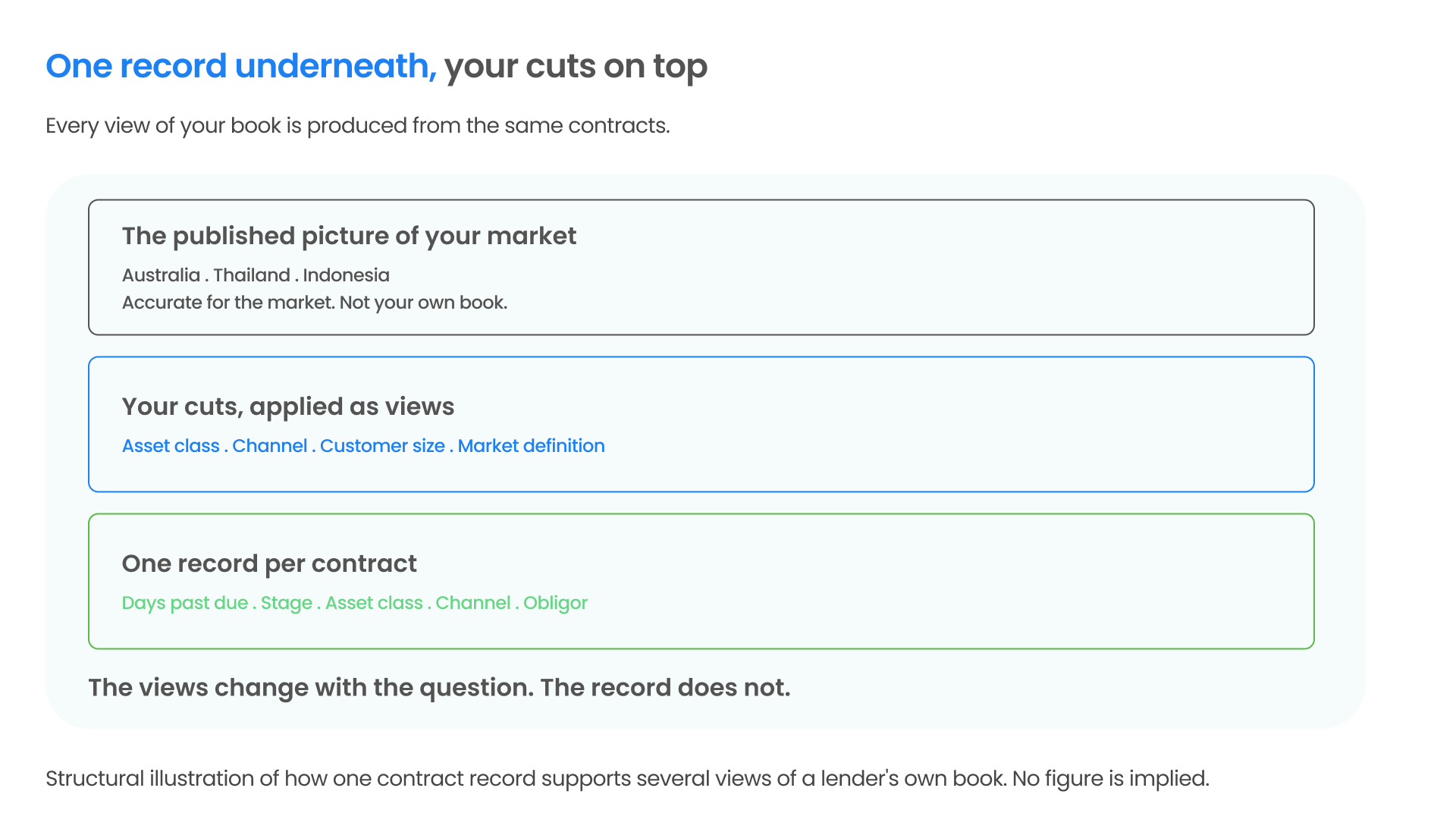
Figure: One record underneath, your cuts on top. The views change with the question. The record does not.
Three layers. The top layer shows the published picture of your market, whether Australia, Thailand or Indonesia. The middle layer shows your own cuts applied as views, by asset class, channel, customer size and market definition. The base layer is one record per contract, carrying days past due, stage, asset class, channel and obligor. Everything above the base is produced from it.
That is what stronger risk oversight means in practice. The same contracts are seen through your market's lens and through your own, in one consolidated view of portfolio performance.
It also settles how current the view is. Bank Indonesia's August figures came with its September policy decision, and APRA's June-quarter statistics were published on 17 September. Real-time data from your own contracts does not wait for a release. Our blog on the asset record covers how one record stays intact across a deal's whole life.
What this means for asset finance leaders
- Ask which published figures for your market you could reproduce from your own contracts.
- Write down how your regulator defines a problem loan, then check your reporting uses it.
- Treat the market average as context and your own segment cut as the number you manage.
Our asset finance whitepapers work through how to build that consolidated view.
Questions about asset finance management software
Why doesn't a published market average describe an equipment lender's book?
It covers a whole system and mixes asset classes, customer sizes and channels. Your book is one slice of that, and the slice can move the opposite way to the total.
What does a consolidated portfolio view need from the underlying system?
One record per contract that holds what your market's definition depends on. Each definition then becomes a view of that record, not a separate book to reconcile.
One portfolio, read your way
Published statistics will keep describing markets. What you can add is the number no bulletin carries, the one for your own contracts.
Transcend Finance brings complex portfolio operations onto one configurable platform. Each contract is a single record. Your market's definitions are configured as reporting views, not rebuilt by hand each quarter. That is how a team reads its whole book in one place through our asset finance software. Pick one number in last quarter's pack and trace it back to the contracts behind it.

Modernise your asset finance operations with NETSOL
Related blogs

Blog
Applying global best practice to UK auto finance software
Blog
Automotive desking software after a mid-month program change

Blog