Blog
An automotive digital retail platform has to finish the deal
By NETSOL Technologies Inc. , on October 15, 2026
Mobile, in-store and paperless are one requirement, not three
Table of Contents
Subscribe to our newsletter
Share this Blog:


Picture a buyer who has chosen the car, the trade and the payment on a phone. The last screen tells them to come in and sign. The deal has not failed yet. It has stopped being mobile, and everything left to do will happen in person and on paper.
An automotive digital retail platform earns its place when one deal moves from the customer's phone to the salesperson on the showroom floor and on to a signature. It does so without being rebuilt. Mobile, in-store and paperless describe a single flow, not three features.
A 30-minute purchase tests the whole deal
NETSOL's MINI Anywhere case study says customers can complete a MINI purchase in just 30 minutes from home, across 60 active MINI dealerships (NETSOL Technologies, 2026).
What made it possible matters more than the number. The case study describes MINI USA and MINI Financial Services building a tool for credit decisioning, eContracting and signatures, so a transaction could finish end to end (NETSOL Technologies, 2026). Speed came from the whole deal sitting in one flow, not from a quick page.
Time-to-contract improves when no step has to wait for a person, a form or a second system. It does not improve when only the front end gets faster.
An automotive digital retail platform must work on the showroom floor
Many buyers start online and still visit. If the salesperson cannot open the deal the customer built, the customer repeats it. The phone session becomes a warm-up. Our blog on how rebates and tax decide the payment a website quotes covers what happens to that payment on the way.
Transcend Retail is built to support buying across digital and in-store touchpoints. Its dealer hub covers desking, trade appraisal, credit decisioning and e-contracting, with live session and lead tracking. A salesperson can pick up where the customer stopped. The test is simple. A buyer should never be asked for something they have already given.
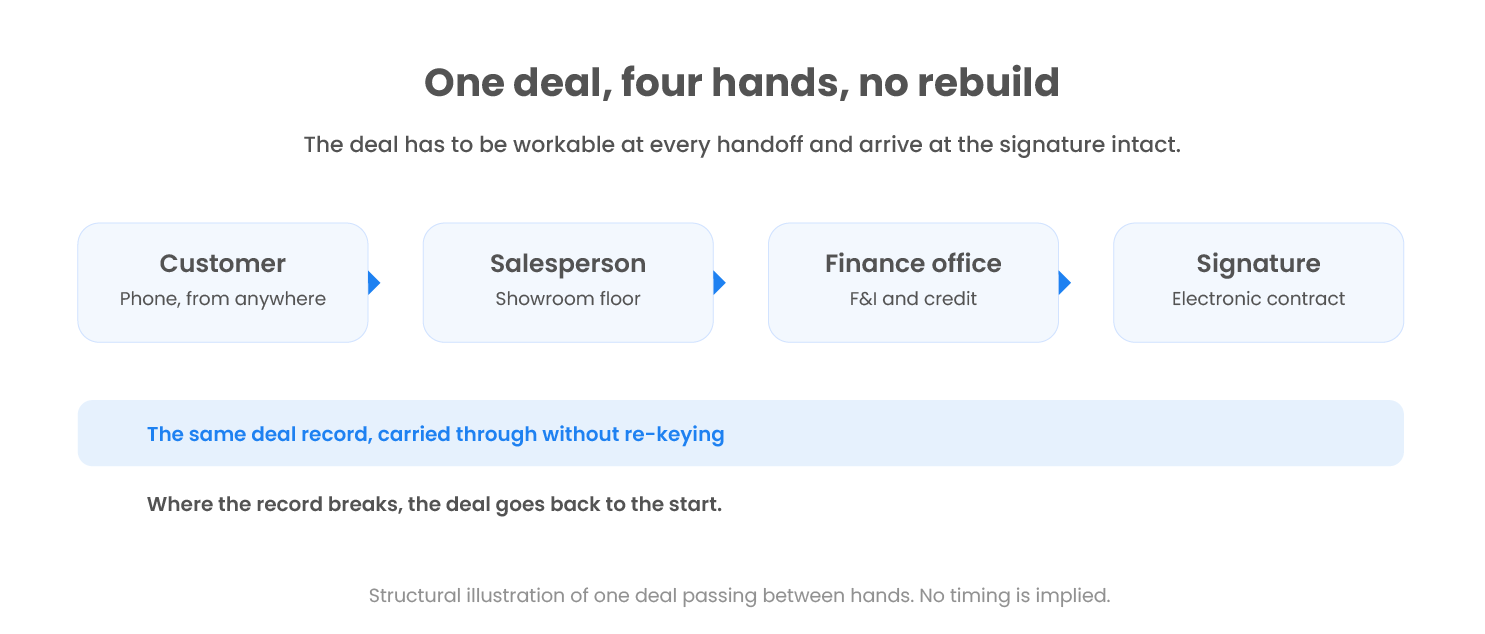
Figure: Every handoff is a chance for the deal to restart. The record has to survive all four.
Paperless has rules a signature pad does not cover
An electronic signature is valid. Under the federal Electronic Signatures in Global and National Commerce Act (ESIGN), a contract may not be denied legal effect solely because it is in electronic form (U.S. Government Publishing Office, 2023). That settles the signature. It does not settle every step around it.
When the law requires information to be given to a consumer in writing, an electronic record counts only if the consumer has affirmatively consented. They must first be told of any right to receive the record on paper. They must also show they can open the electronic format. The Act does not require anyone to agree to electronic records at all.
So a paperless deal should mean every step the customer chooses to complete on screen. Consent is recorded and a paper route stays available. State rules can add requirements, so check yours with counsel. A vendor should be able to say how consent is captured and where it is kept. Our automotive retail guides cover what else to ask.
What this means for dealer principals
- Measure time-to-contract on a purchase that starts on a phone and finishes in the store.
- Test whether the salesperson sees where the customer left off, without asking.
- Ask how electronic consent is captured and where the paper option sits.
Questions about buying a car online
Can a customer really buy a car online in 30 minutes?
NETSOL's MINI Anywhere case study says MINI customers can complete a purchase in 30 minutes from home. That depends on credit decisioning, contracting and signature sitting in one flow. It is MINI's result, and a dealer's own time will vary.
Is an electronic signature valid on a car deal?
Under the federal ESIGN Act, a contract may not be denied legal effect solely because it is electronic. Consumers must consent to electronic records first and be told of any right to paper. State rules can add requirements.
Mobile, in-store and paperless only work as one flow
The three ideas are easy to buy separately and hard to use that way. A fast phone experience that ends at the desk, a floor tool that rebuilds the quote and a paperless contract that restarts the deal each solve one problem. The customer experiences a single purchase, so the platform has to carry it as one.
A platform has to carry the purchase from first click to signed contract. The decision belongs to whoever owns time-to-contract and the finance office's throughput. Transcend Retail comes from a company with over four decades of automotive finance and leasing experience. Its dealer hub carries desking, credit decisioning and contracting in the same flow as the customer's side. At which step does your own online purchase hand back to a person?

If you're in BFSI (Banking, Financial Services, and Insurance), standing still isn't an option.
Related blogs

Blog
Asset finance management software and the average that is not your book
Blog
Applying global best practice to UK auto finance software
Blog