Blog
Transforming BFSI with data engineering: Actionable insights from big data
By NETSOL Technologies , on December 10, 2025
Explore how data engineering is transforming GCC BFSI, with Saudi Arabia advancing AI risk analytics, fraud detection, and real-time financial intelligence through big data.

Table of Contents
Subscribe to our newsletter
Share this Blog:


The banking, financial services, and insurance (BFSI) sector across the GCC region is undergoing rapid digital acceleration. As financial institutions collect massive volumes of data from customer interactions, digital transactions, risk systems, and third-party sources, the need to transform raw data into meaningful business value is more urgent than ever. This is where data engineering becomes a strategic enabler: it provides the architecture, pipelines, governance, and scalability required to unlock actionable insights from big data.
“In Saudi Arabia, the BFSI sector is one of the most dynamic adopters of big data analytics; real‑time fraud detection, risk modeling, credit scoring and customer segmentation are being pursued.” (Industry research)
To understand this transformation, we’ll examine global data-engineering forces, then explore how they shape the GCC’s BFSI landscape, particularly within Saudi Arabia, the region’s fastest-growing digital economy.
The case for data engineering in BFSI
Globally, BFSI organizations are awash with structured and unstructured data. As early as 2011, McKinsey called big data “the next frontier for innovation, competition, and productivity,” highlighting its power to reshape financial services (McKinsey). Today, that insight is even more relevant because AI, analytics, cloud computing, and digital channels have expanded exponentially.
Yet, analytics alone is not enough, as Deloitte argues, data only becomes valuable when engineered correctly, governed end-to-end, and made accessible across the organization (Deloitte).
GCC: An accelerating digital landscape
The GCC region is experiencing one of the world’s fastest digital transformations, driven by ambitious national visions, rising fintech ecosystems, and AI adoption.
“The GCC digital transformation market is expected to grow at a CAGR of ~25.7% during 2024–2030.” (GCC digital transformation CAGR research)
This growth directly fuels the need for enterprise-grade data engineering in BFSI institutions across the UAE, Saudi Arabia, Qatar, Kuwait, Bahrain, and Oman.
The blog on data modernization foundations examines the global architecture shift driving this urgency, why legacy data systems cannot support AI at scale and what modern enterprises are doing to build the infrastructure that makes real-time financial intelligence possible.
Saudi Arabia spotlight
Within the GCC, Saudi Arabia stands out as a regional analytics powerhouse:
“The Saudi Arabia big data analytics market was valued at USD 3.58 billion in 2024 and is projected to reach USD 12.24 billion by 2030 (CAGR ~22.7%).” (Saudi Arabia big data analytics market)
These figures show why KSA often serves as the leading example of data-driven transformation in GCC BFSI.
What constitutes a robust big data solution for BFSI
Understanding the building blocks of data engineering helps illustrate its strategic importance for GCC banks:
- Data ingestion and integration: pulling data from core systems, CRM, digital channels, risk engines, IoT, and third-party data providers. Fragmented systems remain a major challenge across GCC banks, as highlighted by regional studies.
- Engineering pipelines: transforming, cleaning, joining, and preparing data for analytics and machine learning at scale.
- Scalable storage and computation: GCC nations are accelerating adoption of cloud and hyperscale infrastructures to support large-scale BFSI data workloads.
- Governance, compliance, and security: essential in regulated industries, especially as GCC countries introduce new frameworks for cybersecurity, privacy, and operational resilience.
- Analytics and machine learning enablement: powering risk models, credit scoring, fraud detection, customer segmentation, and real-time decisioning.
- Operationalization: embedding insights directly into workflows, dashboards, credit engines, and customer-facing channels.
How BFSI unlocks actionable insights with data engineering
Across the GCC, data engineering is enabling BFSI organizations to rapidly convert raw data into measurable business outcomes:
- Hyper-personalization and customer intelligence: Regional banks are using unified customer views to deliver personalized journeys and offers. More than 80% of GCC banking customers prefer digital banking, reinforcing the need for data-driven CX strategies (Backbase).
- Advanced risk, fraud, and AML analytics: Real-time fraud detection and behavioral risk modelling are now essential. The GCC AI-driven digital banking analytics market is valued at approximately USD 1.1 billion. NETSOL's AI and ML services are built to address exactly these BFSI use cases, from predictive risk modelling and credit scoring through to real-time fraud detection and customer segmentation, using data engineering foundations that make AI outputs reliable and audit-ready.
- Corporate banking optimization: Data-driven insights help financial institutions improve credit assessment, portfolio risk, and cross-sell forecasting.
- Regulatory reporting and governance: As GCC countries roll out open-banking and digital-identity frameworks, data-engineering foundations ensure compliance and data integrity.
Saudi Arabia's advancement in risk and AI
“The Saudi Arabia AI‑Powered BFSI risk management analytics market was valued at USD 1.2 billion in 2025.” (Saudi Arabia AI-powered BFSI risk analytics)
Within the GCC, Saudi Arabia is increasingly seen as a testing ground for AI-driven risk transformation. As banks modernize their cores and consolidate risk data into engineered platforms, they are using AI to move from backward-looking controls to forward-looking, predictive risk management, from early-warning signals and portfolio stress testing to automated monitoring of fraud and compliance breaches.
Recent industry perspectives such as “AI in BFSI: Empowering risk leaders” and “AI in BFSI: Revolutionizing risk management” build on this direction, showing how risk teams can layer AI on top of robust data engineering to strengthen credit decisioning, streamline regulatory workflows, and design more resilient, scalable risk frameworks.
“The Saudi Arabia data analytics market is projected at USD 8.8 billion by 2030 with a ~30.04% CAGR, and Saudi Arabia held ~3.2% of the global data analytics market in 2023.”
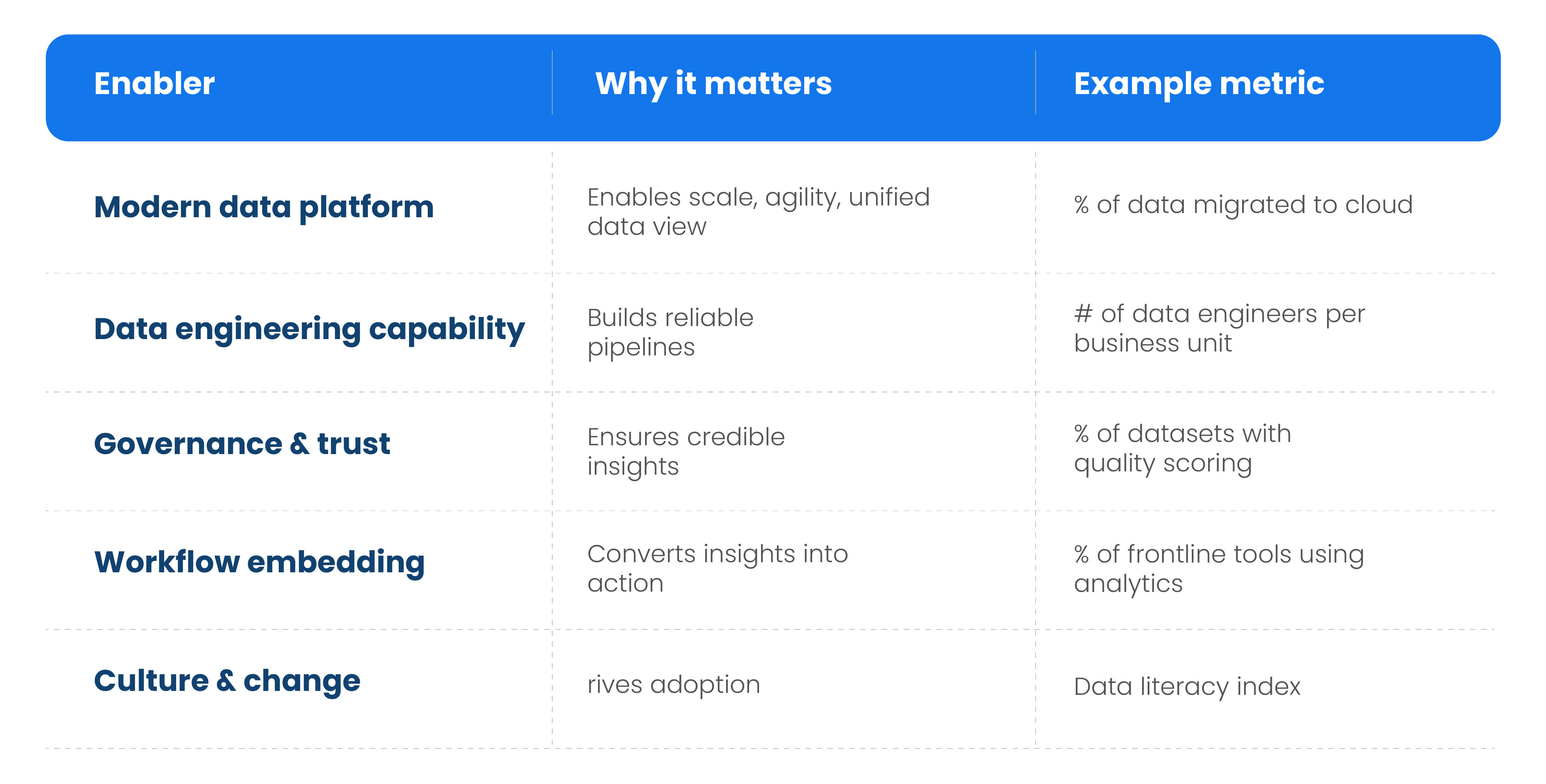
Key success factors and strategic enablers
To maximize value from big data, GCC BFSI organizations must strengthen the following enablers:
- Modern data platforms: Cloud, data lakes, and API-first architectures are becoming standard across GCC banking IT modernization programs.
- Data engineering talent: There is rising regional demand for data engineers, ML specialists, and analytics architects.
- Strong governance and data quality: Trustworthy data is foundational to any AI or analytics deployment.
- Workflow integration: Analytics must reach the front line, informing decisions in real-time.
- Culture and change management: Data-driven transformation requires new ways of thinking, training, and cross-functional collaboration.
Overcoming common challenges in GCC BFSI
Despite strong momentum, GCC institutions still face challenges:
- Legacy systems and data silos
- Shortage of specialized data engineering talent
- Regulatory complexity across multiple GCC jurisdictions
- Difficulty demonstrating ROI for big-data initiatives
- Challenges in operationalizing analytics at scale
The outlook: Unlocking new frontiers
The next decade will see GCC BFSI unlock completely new dimensions of value from engineered data:
- Real-time decisioning and streaming-first architectures
- Generative AI for predictive and proactive banking experiences
- Data-as-a-Service (DaaS) monetization models
- Federated data sharing and privacy-enhancing technologies
“The GCC digital banking market is expected to reach USD 47.6 billion by 2032, growing at a CAGR of ~20.8%.” (GCC digital banking market forecast)
Combined with Saudi Arabia’s projected USD 12.24 billion analytics opportunity, the region is poised to become a global hub for data-driven finance.
Transforming BFSI with data engineering in the GCC is no longer a strategic choice, it is a competitive necessity. With rising digital expectations, evolving regulations, expanding fintech ecosystems, and the growth of AI, financial institutions must build world-class data-engineering foundations to unlock value at scale.
Ready to build the next generation of BFSI analytics?
With 40 years of global expertise, NETSOL helps financial institutions across the GCC and beyond, modernize their data ecosystems, embed AI into operations, and unlock secure, compliant, real-time insights.
For BFSI organisations navigating the intersection of AI adoption, data governance, and client trust, the whitepaper client data and AI provides a framework for deploying AI responsibly, ensuring data is used transparently, ethically, and in compliance with the governance standards that regulators across the GCC are increasingly enforcing. Explore how NETSOL can accelerate your data engineering services transformation today!

Learn how
scalable data
ecosystems
unlock deeper
customer insights.
Related blogs

Blog
What a wholesale lending platform lets you say yes to

Blog
NETSOL is ready for Palm Desert: Transcend Finance to take center stage at ELFA 2026
Blog