Blog
The impact of manual rework on equipment leasing operations
By NETSOL Technologies Inc. , on October 26, 2026
How to find the manual work between approval and servicing

Table of Contents
Subscribe to our newsletter
Share this Blog:


A report can show how many equipment leases were booked last month. It may not show the hours staff spent fixing details between approval and the first bill. Those hours matter when operations asks for more capacity. Without a way to count the work, the headcount request looks like a response to growth alone.
The hidden cost of disconnected equipment leasing software is the time people spend checking and correcting contract details between teams. Follow a sample of agreements from approval to first bill. Count each manual correction and record how long it takes. That gives operations a measure of rework per contract that it can track as volume changes.
Equipment leasing software must carry the agreed date
Consider a lease whose first payment starts after the equipment is delivered. Credit approves that term and documentation puts it in the agreement, but booking receives a different start date. Before the first bill goes out, someone must check the signed terms, correct the booking record and confirm what servicing will charge.
The issue is the handoff, not the lease structure. Each team may have done its own job correctly, yet disconnected systems leave the next team to repair a mismatch. The cost is fragmented across documentation, booking and servicing, so no team sees the whole. The earlier article on equipment payment structures explains how the agreed schedule is set.
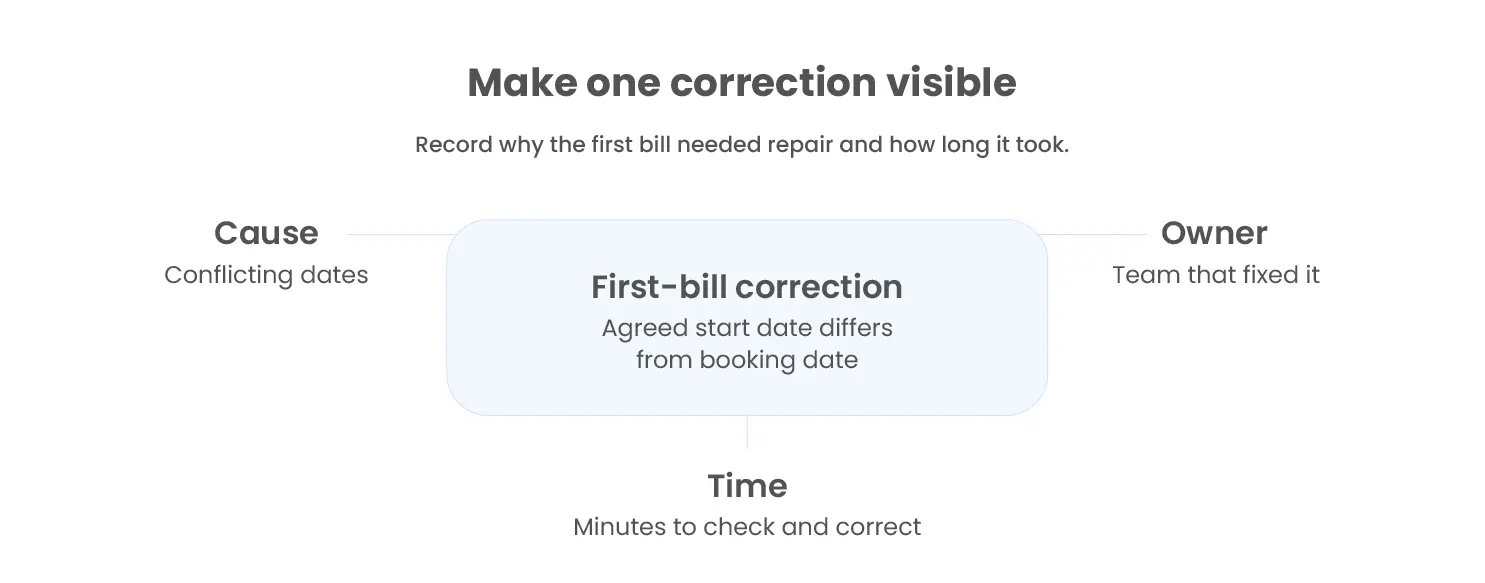
Figure. A handoff becomes a cost when someone has to find and correct a mismatch. Record the cause, owner and time taken.
Growth makes repeated corrections harder to absorb
In the August 2026 CapEx Finance Index, the Equipment Leasing and Finance Association (ELFA) reported a 17.3% increase in year-to-date new business volume among surveyed members over the same months in 2025 (ELFA, 2026). That figure shows higher activity in the survey. It does not measure any lender's rework.
For an individual lender, the useful question is whether manual minutes per agreement stay steady as the book grows. If the same date must be checked on every lease, more volume brings more checking. If only a few agreements need correction, the exception rate matters too. Count both, so the team can separate a busy month from a broken handoff.
Measure the work before buying more capacity
Start with a sample of recently booked agreements. At each handoff, note what staff checked or re-entered, which team did it and how long it took. Include work done through email or a spreadsheet, not only tickets in an exception queue. Then group the corrections by cause, such as a missing field, a conflicting date or a format the next system cannot use.
Add the minutes spent across the sample and divide by the number of agreements reviewed. That gives manual minutes per agreement. Finance can apply a labor cost to the time and compare it across periods. A separate exception rate shows how many agreements needed at least one fix. These measures turn a general complaint about data silos into a problem a lender can investigate.
Use the same exercise in an equipment leasing software demonstration. Ask the vendor to carry one of your agreed payment terms through documentation, booking and servicing. Note where a person still has to check, export or re-enter it. For different assets and products, the lender should be able to configure the workflow without recreating each handoff in a separate system. A useful demo reveals whether the proposed workflow reduces the work you measured.
Our US equipment finance guide follows an agreement beyond booking and shows why later teams need the original terms.
What equipment finance leaders should check
- Count the agreements that need a manual correction before the first bill.
- Record who fixes each issue and the minutes it takes.
- Compare manual time per agreement as contract volume changes.
Questions about the cost of manual handoffs
What counts as a manual touch in equipment leasing?
A manual touch is a check, re-entry or correction a person must make because the next team cannot use the contract information it received. Log the cause and time taken, even if the work happens through email rather than an exception queue.
Will connecting two systems remove the rework?
An integration can move data between systems, but it may still pass a field the receiving team cannot use. Test a real contract term across the handoff. If someone must verify or repair the result, count that work when comparing solutions.
The cost is in the correction, not the contract count
Contract volume tells a lender how much business arrived. It does not show how often staff had to repair the information that moved with it. Once operations counts corrections and time per agreement, it can tell whether a request for more capacity reflects more business, repeated rework or both. That is a more useful basis for deciding what to change.
Transcend Finance combines origination, contract management, servicing and asset management in a single, integrated platform. Its API and Integration Hub connect surrounding systems. Count the handoffs on your last funded deal, then tell us the number.

Modernise your asset finance operations with NETSOL
Related blogs

Blog
What a wholesale lending platform lets you say yes to

Blog
NETSOL is ready for Palm Desert: Transcend Finance to take center stage at ELFA 2026
Blog