Blog
Changing a credit rule in auto lending software
By NETSOL Technologies Inc. , on October 20, 2026
A practical test for UK motor finance lenders
Table of Contents
Subscribe to our newsletter
Share this Blog:


A UK lender decides that applications above a chosen amount should go to a credit specialist before an offer is made. Its credit team approves the policy. Now someone has to put that decision into the lending system. Can the lender change an existing rule, or must it ask for software development?
Auto lending software can make an approved credit-rule change easier when the platform already supports it through configuration. The lender still needs to test and approve the change before it goes live. If the rule cannot be configured, it needs development or a vendor change. Ask a provider to show both routes using one of your own rules.
Follow one change from decision to live rule
In this example, the lender wants applications above its chosen amount to be referred for manual review. The amount is a policy choice. The lender must also decide which products the rule covers and what process the credit team follows when an application is referred. Those are connected parts of one decision, not three separate projects.
Once the lender has approved the decision, the delivery team should be able to answer a simple question. Does the platform already let us set this rule and referral workflow? If it does, the team can configure the supported options, test sample applications and seek approval to release the change. If it does not, the team needs to specify what must be built and agree a delivery plan.
The distinction matters because a request labelled “small” can still involve a build. A credible vendor should show the boundary rather than promising that every rule is configurable.
Two routes for the same approved referral rule. If supported, the rule and workflow are configured, tested and approved before release. If unsupported, the lender and vendor specify the change, build and test it, then release it. Neither route implies a fixed delivery time.
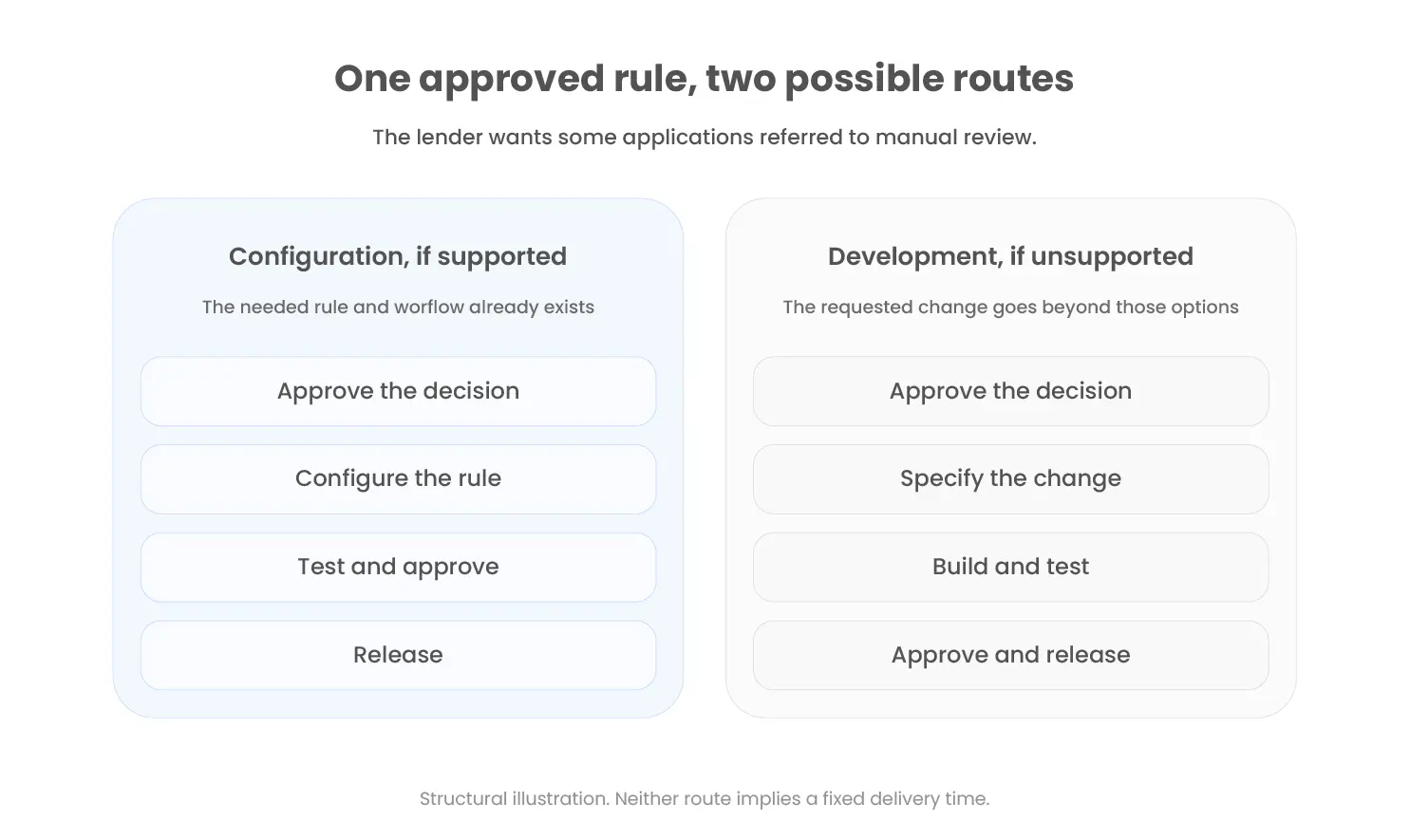
Caption: One approved referral rule can take a configuration route or a development route. Both need testing and approval.
Regular product reviews can lead to system changes
The Financial Conduct Authority (FCA) expects firms in scope of the Consumer Duty to monitor products regularly to check that they continue to meet customer needs. A review may leave a product unchanged, or it may lead a lender to revise a product, policy or process. The FCA does not prescribe the referral rule in our example.
For firms covered by the Duty, the practical question is how an approved review finding becomes a tested system change. Configuration may shorten that route for supported changes. It does not remove the need for the lender's own approval process. Our article on UK-specific rules in auto finance looks more closely at what needs local judgement.
Check the route that the software cannot configure
Ask the provider to demonstrate the referral change. Which parts can be configured today? Who would make the change, test it and approve its release? Which parts would need development, and how would that work be priced and scheduled? The answers reveal more than a general claim about flexibility.
Check connected systems too. If an application portal must show the referral outcome, ask the provider to show how that result reaches it. An API connection can carry data between systems, but it does not make a new lending rule configurable.
What this means for UK lending leaders
- Take one real, approved change to a software demonstration.
- Ask the provider to demonstrate the rule and identify any work beyond configuration.
- Record the owner, approval step and likely delivery time for each route.
Our automotive finance research considers how lenders fit technology to their own business.
Questions about configurable auto lending software
How can a lender tell whether a rule needs development?
Configuration changes options the software already provides, such as supported rules or workflows. Development adds or changes software where those options do not cover the request. Either route still needs testing and approval before release.
Can every lending rule be changed through configuration?
No. The answer depends on the rule and the platform. Ask the provider to demonstrate a change from your own policy and identify any part that needs development. Agree who will deliver that work, how it will be priced and when it could be released.
The useful answer is a demonstrated route
The lender in our example needs more than a promise of flexibility. It needs to know how an approved referral rule reaches live applications, who checks it and what happens if the request exceeds the platform's configuration options. Software should fit around the lender's approved policy where it can, with a clear plan for the rest. That is the test to repeat whenever products, policies or processes change.
Transcend Finance has configurable business rules and workflows, with APIs and an integration hub for surrounding systems. If you are weighing a specific change, we can work through its route with you.

Modernise your asset finance operations with NETSOL
Related blogs

Blog
Equipment finance system migration is a data problem first

Blog
An automotive digital retail platform has to finish the deal

Blog