Blog
Applying global best practice to UK auto finance software
By NETSOL Technologies , on October 5, 2026
Where to take the answer a global platform already has, and where the UK has to decide for itself

Table of Contents
Subscribe to our newsletter
Share this Blog:


UK lenders are waiting on a rule that does not exist yet, and their auto finance software has to be ready for it anyway. That is an odd thing to buy for. It is also the test that decides what a platform is worth.
The Financial Conduct Authority (FCA) launched a redress scheme for historic car finance commission. Then parts of it were suspended after a legal challenge. The case is due to be heard in December 2026 or February 2027 (Financial Conduct Authority, 2026a).
Around 12.1 million agreements sit inside that scheme, on the FCA's own estimate. Every lender holding some of them has to act on an answer nobody has yet. That is what evolving regulatory expectations means in practice.
A global record answers some of your questions
A vendor working across many markets arrives with real advantages. Most of what a lender needs works the same way everywhere. Writing a deal, servicing it, chasing it and funding a dealer are common problems. The solutions travel. Rebuilding them locally wastes money on work somebody has already finished.
That is where international experience earns its place. Take the global answer wherever the need is shared. Spend your own effort on the part that is not. The judgement that separates the two is what our blog on transformation risk calls advisory depth.
Some UK requirements have no global equivalent
Voluntary termination is the clearest case.
Under the Consumer Credit Act 1974 a customer can end a regulated hire purchase agreement early. Section 99 gives that right at any time before the final payment falls due. Section 100 then limits what they owe to half the total price, less what they have already paid.
No global best practice covers this, because most markets have no equivalent. A platform configured elsewhere has never been asked the question. Either your system handles a voluntary termination or your people handle it beside the system. Only one of those leaves a record anyone can audit.
That is what localisation actually means. Not spelling and currency, but the handful of places where the local answer has to win outright.
Balancing global innovation against UK needs in auto finance software
A global platform improves on a roadmap built for every market it serves. Your obligations arrive on a schedule set by one regulator, for one market, often at short notice. Those two calendars will never align.
Lenders get this wrong in both directions. Take everything global and you inherit defaults that were never tested against UK rules. Build everything locally and you fork yourself off the roadmap. Each future release then becomes a project rather than an upgrade. The UK version then stops improving.
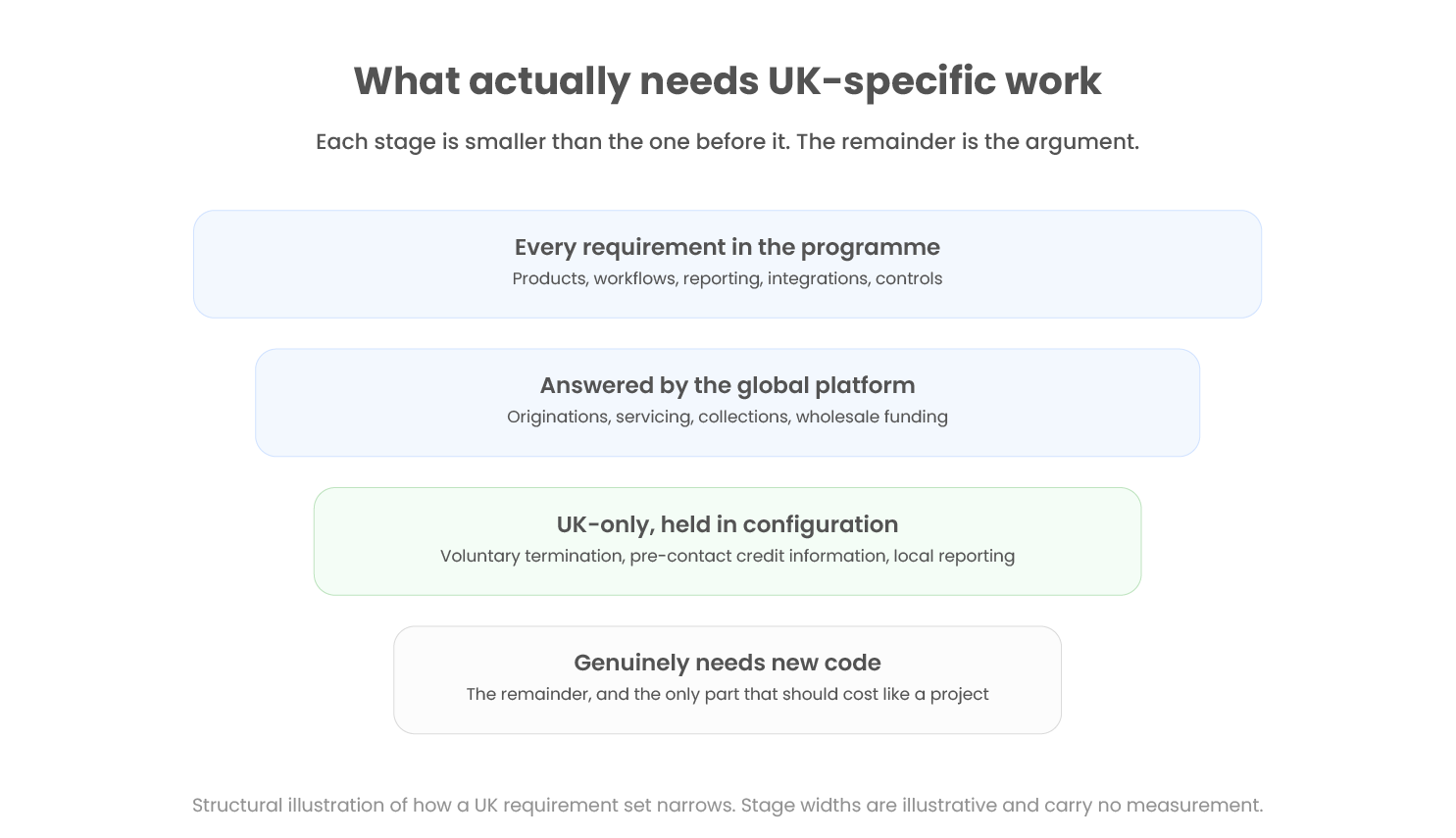
Figure: Most of a UK programme is already answered. The argument is about what is left.
The answer sits in the middle. Keep the shared parts on the global roadmap. Hold the UK-only parts in configuration, where you can change them yourself.
Expectations that have not finished moving
The redress scheme is not unusual. The FCA publishes Consumer Duty findings through the year, with two issued in 2026 (Financial Conduct Authority, 2026b).
So the question in selection is not whether a platform meets UK rules as they stand. It is how quickly it can meet the next version. And whether that needs your own team or a vendor release.
What this means for UK lending leaders
- Split the shared needs from the few that are UK-only, then resist building your own version of the first.
- Ask how a UK rule change reaches the platform. A setting your team can change beats a release you have to wait for.
- Test a vendor on a rule that has not settled yet, because that is the honest version of the years ahead.
Questions UK lenders ask about localisation
How much of a global platform usually needs UK-specific work?
Less than lenders fear on capabilities that exists everywhere. More than they expect on the few that do not, such as voluntary termination and pre-contract credit information. Whether those sit in configuration or in code decides the cost.
What happens when UK rules change after we go live?
That depends on where the rule was implemented. A change held in configuration can be made, recorded and evidenced by your own team. One written into custom code waits for a release. That is why forking a platform stays expensive for years.
Global experience, applied rather than imported
Global experience is what you buy. Local configuration is what you own, and it is where the success of a UK programme is built.
Every market on Transcend Finance runs on the same core platform. What makes the UK different is held in settings, not code. So, when a rule changes, your team updates the setting. There's no rebuilding and no waiting for the next release. Every change is recorded. What changed, who approved it and when. You move faster, and you can prove exactly what you did. The automotive finance platform behind it is built for your success. So, which UK rule change would your platform handle without a release?

Modernise your asset finance operations with NETSOL
Related blogs

Blog
What a wholesale lending platform lets you say yes to

Blog
NETSOL is ready for Palm Desert: Transcend Finance to take center stage at ELFA 2026
Blog