Blog
Lease Management Software for Asset Finance Companies: How to Choose the Right System
By NETSOL Technologies , on November 13, 2018
A practical guide for lessors and asset finance companies evaluating lease management software, covering APIs, SaaS architecture and end-to-end lifecycle management.

Table of Contents
Share this Blog:


For asset finance companies and lessors managing complex lease portfolios, selecting the right lease management software is one of the most consequential technology decisions you'll make. The global leasing industry processes billions of dollars in daily transactions — and the system underpinning those operations needs to be stable, flexible, and built for scale. Enterprise lease management systems, unlike traditional IT solutions, are purpose-built to handle that complexity without breaking under volume.
Enterprise systems are software packages that help in automating business processes and improve workflow and decision making. When it comes to specifically choosing a lease management, certain aspects of the software need to be taken into account before deciding which system would best suit your business requirements.
Stability and Reliability in Lease Management Systems
As mentioned earlier, the daily transactions in the leasing industry are worth billions of dollars. As a result, ensuring that the lease management software your company is using is stable and thus reliability is a key priority. The system should be dependable and should not choke at any stage of operations. It should maintain its stability even when lease volumes increase abruptly or show a sign of slowing down. Enterprise systems, compared to traditional IT solutions have the advantage of being more reliable and stable when scaling services up or down as per requirements.
Integration and Open API Compatibility
For asset finance companies operating across multiple markets, integration capability is non-negotiable — your lease management system must connect cleanly with origination platforms, DMS systems, and third-party lender tools without custom builds every time.
The lease management software should be easy to integrate with other third-party systems or software. For a long term mutually beneficial relationship, the lease management software being offered should have flexibility so that clients can access your interface and have the capability to customize the software package according to their specific needs. The end user or client can come up with new functionalities for the software by combining it with other applications thus allowing room for greater innovation with relative ease. Vertical and horizontal integration between suppliers, vendors, end consumers and internal departments of an organization can result in streamlining operations, which will in turn, increase efficiency.
In the short run, a single vendor solution might seem sufficient for current operations, however in the long term, when a business has to face new challenges; it needs to use latest innovative and adaptable software solutions for problem solving. Integrating new features into an inflexible lease management system or switching to a new system altogether will not just be costly, but also time consuming and expose the business to unwanted risks. Having open APIs (Application Programming Interfaces) is one of the best solutions for easy integration between platforms, a requirement the Finance & Leasing Association has increasingly highlighted in its technology guidance for member firms. Open APIs help streamline entire operations ecosystem and can future proof your lease management software by allowing it to easily integrate with new upgraded versions of different applications and systems. A complete lease management system should integrate all aspects of the lease contract lifecycle from origination to completion - and growing demand for this capability is one reason the lease management software market has expanded consistently year-on-year.
Mobile Integration and Remote Access
The Internet of Things (IOT) continues to cause disruption in the way internal and external communication is carried out by enterprises. Companies increasingly become dependent on enterprise collaboration tools such as ROBO (remote office/branch office) as there is a growing need for collaborative tools in and out of the office. Such collaborative mobility applications help bridge the gap between users, resources and data. Data and important information can be retrieved on the go.
Due to the digital revolution, having mobile integration or a mobile version of your solution/system has become an absolute necessity. Sales workforce individuals spend most of their working hours in the field and can access important data and work tools from anywhere at any given time. This enhances the sales teams' ability to make informed decisions more efficiently. They can also add new customer data instantaneously, which means, real time upgrading of client data is just a matter of few clicks. Sales teams don't have to wait to get to the office to add a new lessee to the system; in fact, they can proceed with the entire auto loan origination software and documentation process from the field. They can access and add real time leasing data through their smart phones, which means they can have their workstation in the palm of their hand. This gives sales representatives the freedom to concentrate on their core tasks in the field rather than spending time behind the office desk gathering and updating sales data.
Web Responsiveness Across Devices
The enterprise system or software package needs to be highly web responsive. Web responsiveness is a key element for the success of any application or software package. Digitization is a reality which is presently affecting every industry and therefore, it is increasingly important that your enterprise system performs well across all digital platforms. Web responsiveness of any application on tablets and smart phones being used by sales workforce or others to retrieve and add real time data is a very important element. If a leasing agent is not able to deliver the required information to a client on time or add their information in their system aptly, it would not just give an unprofessional image of the entire company and cause embarrassment, but it would also make the salesperson's job more time consuming and tedious.
Software-as-a-Service (SaaS) for Lease Management
Software-as-a-service (SaaS) solutions are cloud-based platforms that can be accessed over the internet. These platform's infrastructure is 'cloud' based and can be accessed anywhere, anytime through a web browser. As opposed to traditional leasing software models, SaaS models do not need to be installed on your system and are usually on a subscription or pay-as-you-use basis. As no software is to be installed on your company's network, there is no licensing fee and the upgrading costs are minimal. As infrastructure is already established in the cloud, there is barely any time required for set up and you are fully functional in a matter of minutes. Data storing and retrieving is also more straight-forward as you simply need to be connected to the internet to access the platform.
Accuracy
As the entire lease management cycle is automated when using a lease management software, the calculations are also done by the software. As the value of lease contracts in terms of US dollars or other currencies tend to be high, even a small discrepancy in calculation can cause a significant loss. Hence, lease management software eliminates the chances of error as calculations are done as soon as data is entered in the software. Real time inventory management further enhances and updates the calculations.
Data Usage
Diversified and vast amount of data is stored and generated in the lease management software. This data also contains contact information of clients. This customer data base gathered is particularly useful for marketing purposes in the future. Furthermore, information about client's credit scores is also obtained through the credit bureau along with their preferences of type of financial products they use. This data can be used for cross and up selling purposes by understanding their current choice of financial products and their ability to obtain further credit.
Data Migration
Another important aspect to consider is data migration which is the transference of data between data bases or storage systems or sometimes simply transferable in data formats. Lease management systems usually have a built-in data migration system and the vendor providing the management system is responsible for the successful migration of data, if need be. Businesses using the lease management system therefore do not have to worry about loss of data at any stage, as data back up and migration are domains covered by the software vendor.
Big Data and Artificial Intelligence
If you are using a lease management software, the vast number of daily transactions on your platform are bound to create Big Data. This data when analysed over a period of time can be used to create useful insights. Predictive modelling can be carried out combining these data insights with Artificial Intelligence (AI). AI can be used for data modelling and in some cases even automatic decision making where possible. Customers' leasing behavior can be predicted, and certain aspects of decision making can be automated resulting in more informed and swift decision making.
Security
Security breaches into corporate information systems are on the rise globally. When it comes to lease management system, it is significantly important to protect lease transaction data as well as secure customers' information, especially their personal credit information. Software providers have high tech facilities to keep data secure and ensure constant data backups. Businesses can concentrate on their core leasing activities while securing servers and systems from breaches. The responsibility for server security, uptime, and patch management shifts to the software provider — freeing your team to focus on core lease operations. For a broader view of how technology is reshaping these responsibilities, see how digital transformation in asset finance is changing the security and compliance landscape for global lessors.
System Versatility
Different financial services and products should be handled using a single lease management software. All types of leases can be handled by a single system, including operating lease, financial lease, leaseback, etc. Diversified financial portfolios utilizing different financial products should all be worked upon using a comprehensive lease management software.
Telematics in Leasing
Telematics, on the whole is technology that enables devices or machines to store, receive and communicate information. Vehicle navigation systems these days have a black box or vehicle telematics center fitted in them. This black box not only tracks the movement of your vehicle but also records driving behaviour and patterns of use by the vehicle driver. This telematics recorded can be used to provide different leasing solutions to vehicle drivers. Just as you can use pay-as-you-go insurance services which depends upon your driving history and how safely you drive, getting flexible lease options according to your driving behavioral pattern and usage-based lease plans might be an option in the near future.
Choosing the Right Lease Management Software for Your Business
The right lease management system does more than automate calculations — it serves as the operational backbone for everything from origination through contract completion, across every asset class and market your business operates in. As lease portfolios grow in complexity, the gap between purpose-built platforms and generic enterprise software becomes impossible to ignore.
NETSOL's asset finance software solutions are built to cover the full lease lifecycle, handling SaaS-based origination, end-to-end servicing, open API integration, and reporting across global operations. To see how this translates in practice, explore how Maple Commercial Finance streamlined their asset finance operations using NETSOL's platform.
For a focused look at how technology enablement is reshaping broker and vendor finance, watch Broker Brilliance: Elevating Asset Finance with Technology Enablement, a practical discussion on what the right platform choice looks like for growing lessors.

Related blogs
Blog
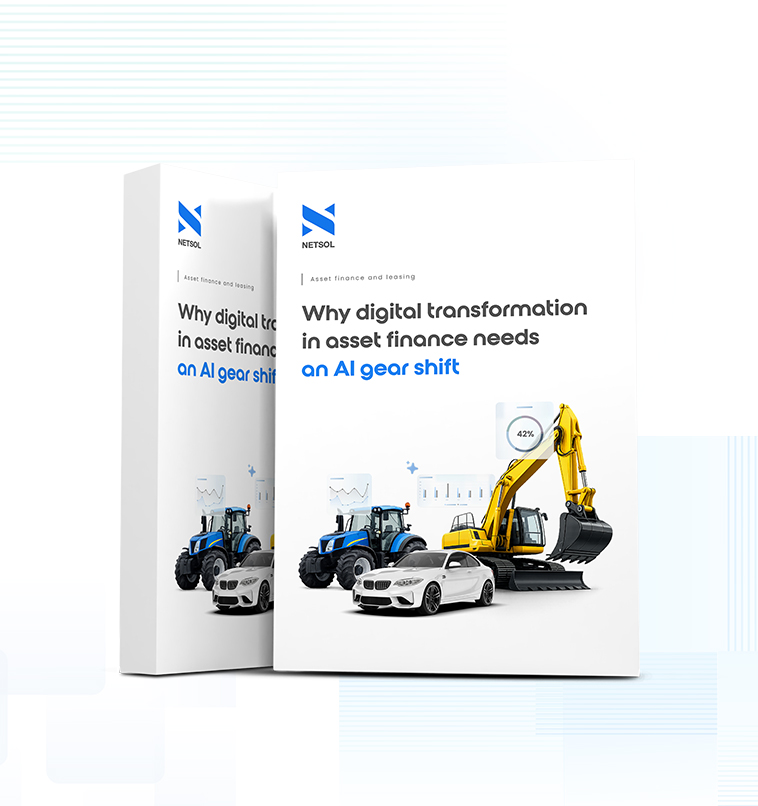
Four in five asset finance leaders want to integrate AI – but nearly half of IT budgets are stuck maintaining legacy systems
Blog
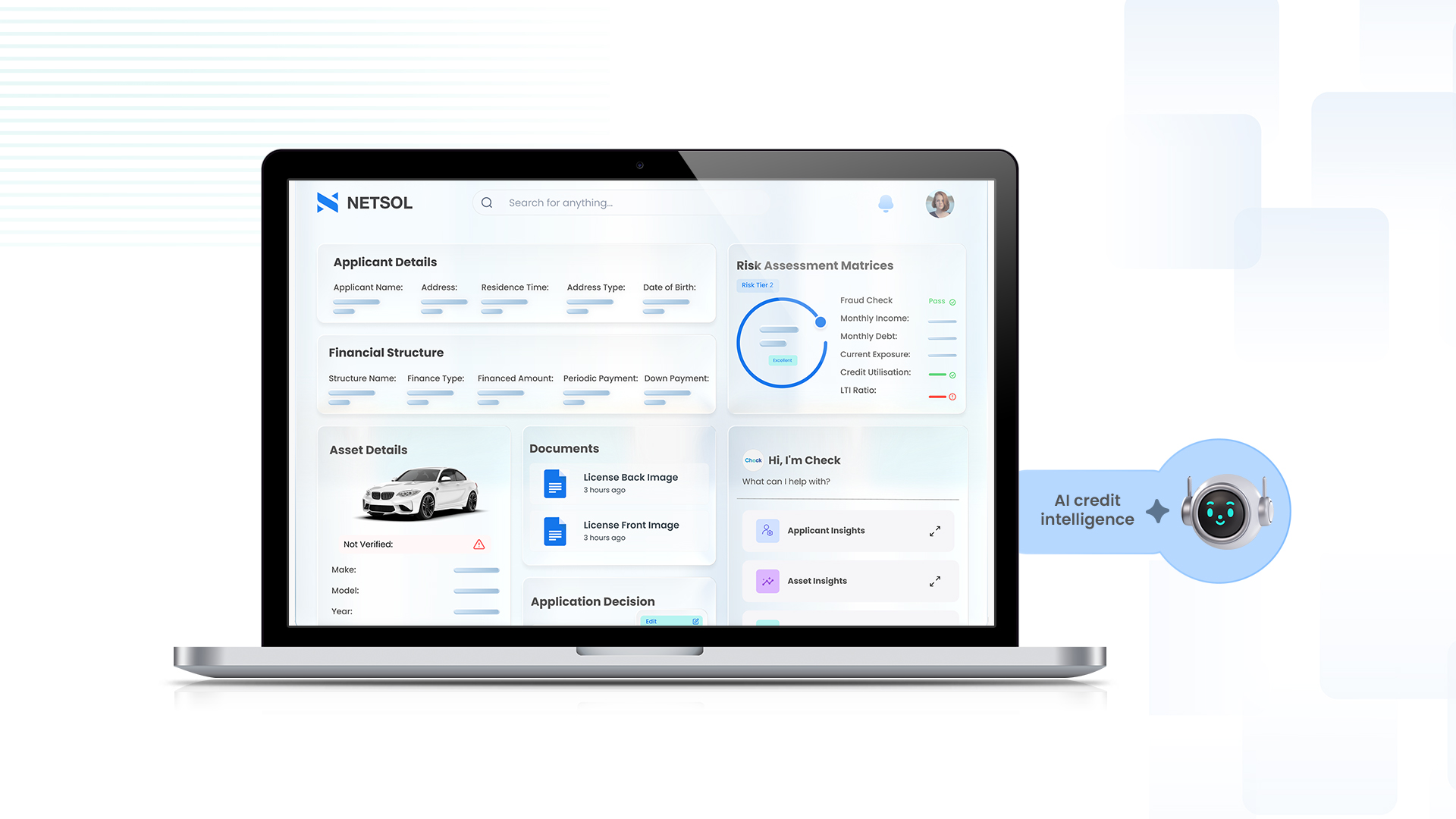
From credit checks to credit intelligence: How AI is redefining underwriting for captives
Blog