The importance of knowledge continuity – Lessons from the field
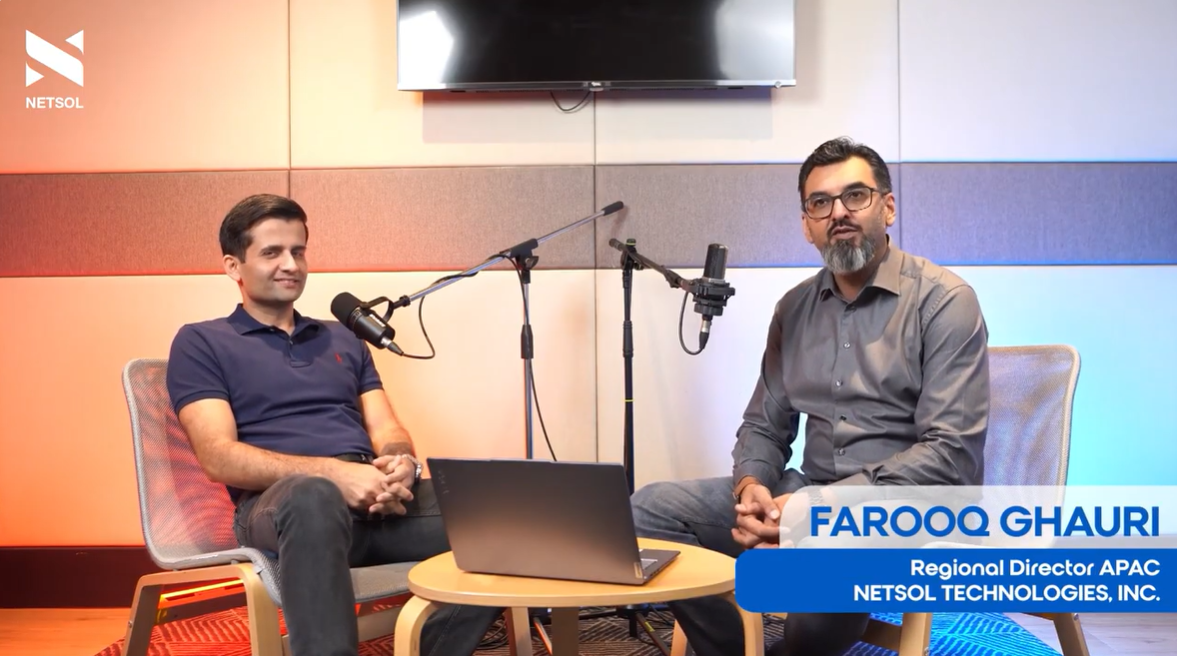
In this episode of the NETSOL Podcast, Farooq Ghauri, Regional Director APAC, addresses one of the most consistently underestimated risks in long-term asset finance lending solutions implementations: the loss of institutional knowledge when team members leave mid-project. Drawing on firsthand experience across large-scale APAC deployments, Farooq examines the strategies—shadowing, structured documentation, role rotation, and a leadership-driven knowledge culture—that determine whether an organisation retains the expertise it needs to deliver consistently over multi-year cycles. As he puts it plainly: "In these multi-year projects, nobody stays for the whole duration, and that's what you have to plan for."
About this episode
Asset finance implementations typically run between two and five years. In that time, key personnel change, analysts move on, project leads are promoted, client-side sponsors rotate out, and vendor teams reshuffle. Every departure carries the risk of taking undocumented expertise with it. When knowledge exits faster than it is captured and transferred, the programme slows, decisions get repeated, and the institutional understanding of why certain design choices were made quietly disappears.
This episode explores why knowledge continuity is not a HR problem or an afterthought, it is a delivery risk that belongs in the programme plan from day one. Farooq examines what proactive knowledge management looks like in practice for lease and loan management platform implementations and what distinguishes organisations that navigate team transitions without disruption from those that stall every time a key person leaves.
What you'll learn
This episode is built for programme directors, delivery leads, client-side transformation managers, and technology executives overseeing multi-year asset finance platform implementations. It covers:
- Why knowledge continuity must be treated as a programme risk, not an HR issue and how to plan for it from the project outset.
- The most common points in a long-term implementation where knowledge loss is most likely to cause delivery disruption, and how to protect against them.
- Practical frameworks for knowledge transfer: shadowing protocols, structured documentation standards, role rotation strategies, and when each is most effective.
- How leadership behaviour shapes a knowledge culture and why teams whose leaders model knowledge sharing perform consistently better during team transitions.
- How AI is beginning to change how institutional knowledge is captured and made accessible in complex financial environments.
Key themes from the discussion
Three principles shaped the conversation:
- Plan for turnover, not against it. The organisations that handle knowledge loss best are not those that try to retain every critical team member; they are those that design their programmes as if departure is inevitable. Farooq's core point is that knowledge continuity is a structural problem, not a personal one. Roles must be documented, processes must be transferable, and onboarding new team members mid-implementation must be fast enough not to derail delivery. The companion blog on knowledge continuity in asset finance covers the full framework Farooq outlines, including specific tactics for each phase of a multi-year implementation.
- Shadowing and role rotation are underused. Of all the knowledge transfer mechanisms discussed, Farooq reserves particular emphasis for shadowing, not as a training tool but as a structured continuity mechanism. A team member who shadows a critical role for several months before the original holder departs carries meaningful institutional knowledge that no documentation can fully replicate. Similarly, planned role rotation ensures that knowledge is distributed across the team rather than concentrated in single points of failure. The Maple Commercial case study shows how NETSOL built this kind of distributed delivery capability for a fast-growing Australian asset finance startup operating in NETSOL's APAC region.
- Leadership defines the knowledge culture. Farooq is direct on this: documentation standards and shadowing protocols only work if the people at the top of a programme visibly model knowledge-sharing behaviour. When senior leaders treat knowledge as a competitive advantage to be held individually rather than a delivery asset to be shared, that culture cascades downward. Building genuine knowledge continuity requires leaders who make capturing and transferring expertise a priority, not just in policy, but in practice.
Going deeper: Related reading
For organisations looking to build the strategic foundation that knowledge continuity requires before a long-term programme begins, the whitepaper importance of strategic clarity examines how clarity of intent at the programme outset shapes every subsequent delivery decision, including how knowledge is managed and protected over time.
Related podcasts
Data Migration in Asset Finance: Strategies, Pitfalls & Real-World Insights
Navigating change management in long-term projects – Lessons from the field (episode 3)

Strategy with Jason podcast featuring NETSOL's Adam Bruttell (Digital auto retail)