Blog
Knowledge Continuity in Asset Finance: Lessons from the Field
By NETSOL Technologies , on December 5, 2025
Learn how NETSOL ensures knowledge continuity in multi-year asset finance projects through shadowing, documentation, and strong leadership practices.

Table of Contents
Subscribe to our newsletter
Share this Blog:


“In these multi-year projects, nobody stays for the whole duration, and that's what you have to plan for.” - Farooq Ghauri, Regional Director for APAC, NETSOL Technologies
In long-term financial projects, especially in asset finance solutions, ensuring knowledge continuity is crucial. It’s a challenge that often goes unnoticed until it’s too late. On NETSOL's latest podcast, Farooq Ghauri, Regional Director for APAC, shared valuable insights on how knowledge loss during staff transitions can derail multi-year implementations, turning what should be a smooth journey into a drawn-out, costly process.
What is knowledge continuity?
Knowledge continuity refers to preserving expertise, experience, and strategic insights within an organization. It’s about ensuring that valuable knowledge isn’t lost when key team members leave and that it evolves as the business grows.
“In a multi-year project, you can’t expect one team to remain intact from start to finish. People come and go, and knowledge must flow seamlessly across teams.” - Farooq Ghauri, Regional Director for APAC, NETSOL Technologies.
The hidden risks of knowledge loss
The risks associated with knowledge loss during transitions are significant, especially in asset finance projects that span years. Farooq highlights a recurring problem in many long-term projects: when experienced staff members leave or are replaced, the knowledge they hold often leaves with them.
“Project fatigue is real. In a five-year project, people are bound to leave or change roles. The bigger risk is the knowledge gap that opens up when someone leaves and no structured plan is in place to preserve that expertise.” - Farooq Ghauri, Regional Director for APAC, NETSOL Technologies
This knowledge gap can lead to costly delays and reduced operational efficiency in complex asset finance projects, which involve multi-layered processes and systems.
The blog on navigating change management in long-term projects addresses the closely related challenge of keeping teams and organisations aligned through multi-year transformations, the same environment where knowledge gaps most frequently emerge and cause project derailment.
Best practices to ensure knowledge continuity
NETSOL has implemented several strategies to maintain knowledge continuity, ensuring that expertise is not lost during transitions.
1. Shadowing and mentoring
Every team member at NETSOL has a backup resource, someone trained and ready to step in should the primary resource leave. This ensures that critical knowledge remains within the team.
"Every resource has a backup resource. These backups are not just trainees; they’re equipped with the same skill set, ensuring that when someone needs to leave, the knowledge gap is immediately filled." - Farooq Ghauri, Regional Director for APAC, NETSOL Technologies
2. Comprehensive documentation
Solid documentation is another key strategy. It ensures that all project information, from user requirements to technical specifications, is well-recorded and easily accessible for new team members.
“Documentation is critical. I’ve seen multi-decade projects succeed because of solid documentation. When key people leave or new technologies are introduced, having well-organized, accessible documentation means the team can continue moving forward without missing a beat." - Farooq Ghauri, Regional Director for APAC, NETSOL Technologies
NETSOL's Maple Commercial case study demonstrates what these practices produce in measurable terms, a 60% reduction in deployment time and 40% reduction in costs on an APAC implementation, delivered through the kind of structured knowledge transfer, agile delivery, and team continuity Farooq describes in this episode. Asset Finance Connect covered the Maple Commercial go-live in detail, providing independent coverage of the deployment outcomes.
3. Knowledge sharing
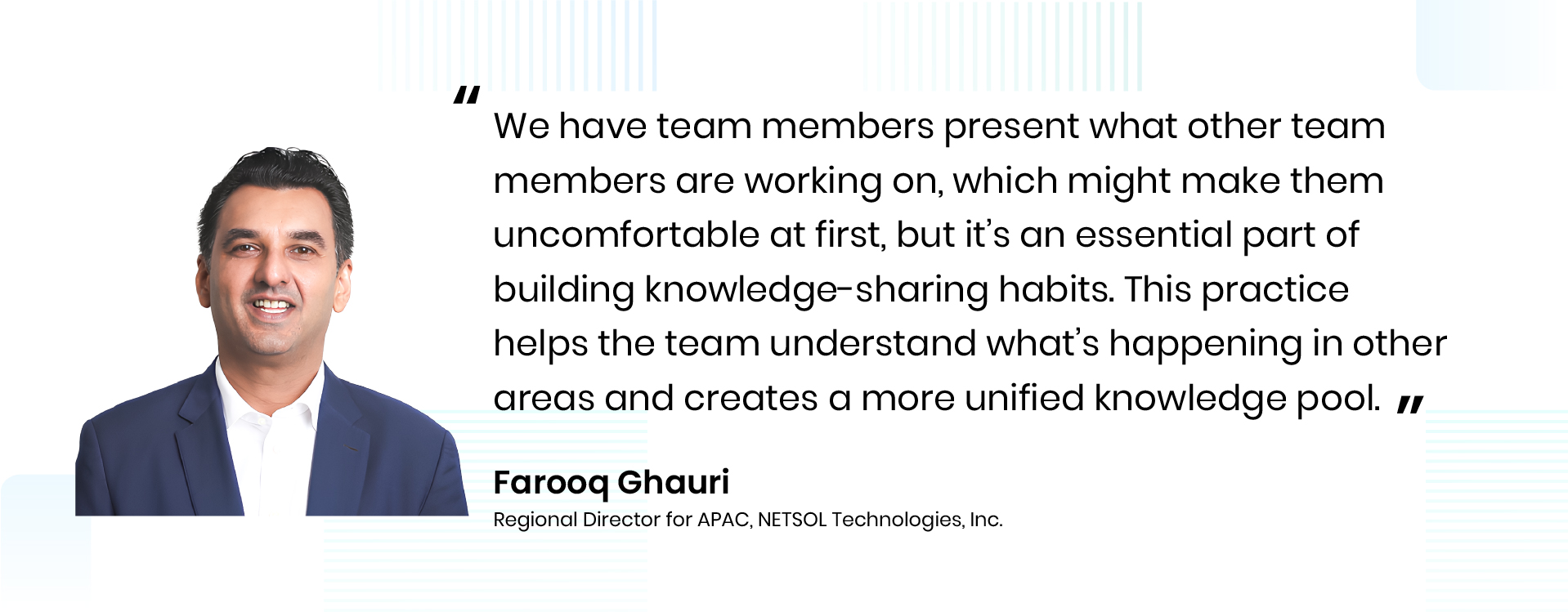
Farooq also advocates for an open knowledge-sharing culture within the team. At NETSOL, team members are encouraged to present their work and insights to their colleagues, which not only helps with cross-functional understanding but also strengthens the overall knowledge base.
Real-world example: a case from the field
Farooq shares an example from an equipment finance project in Australia and New Zealand. The project involved multiple products and a two-country, phased implementation. By documenting processes and sharing knowledge across teams, the project remained on track, even as team members changed roles.
“We did the design phase for the two countries together because the requirements overlapped. Even though people changed roles during the project, the documented processes and the shared knowledge from the design phase helped us deliver on time, without compromising quality or regulatory alignment.” - Farooq Ghauri, Regional Director for APAC, NETSOL Technologies
This example highlights the importance of planning for knowledge continuity from the outset. By documenting every phase and sharing insights across borders, NETSOL was able to minimize the risks of knowledge loss, even as team members rotated in and out.
Tools for knowledge continuity
NETSOL uses several tools to support knowledge continuity. On the sales side, CRM systems ensure customer relationships are not disrupted when team members change. For development teams, tools like Jira and Workday help maintain continuity by tracking user stories and project requirements.
“We use these tools to ensure that, no matter who is on the team, the project can continue without missing a beat.” - Farooq Ghauri, Regional Director for APAC, NETSOL Technologies
These tools help maintain a centralized knowledge base, allowing new team members to quickly integrate and contribute to the project, reducing delays caused by knowledge gaps.
The leadership mindset: Prioritizing knowledge capture
For knowledge continuity to succeed, it needs to be embedded in the company culture and supported by leadership. Farooq emphasizes that without the backing of senior management, knowledge continuity initiatives can quickly fall by the wayside.
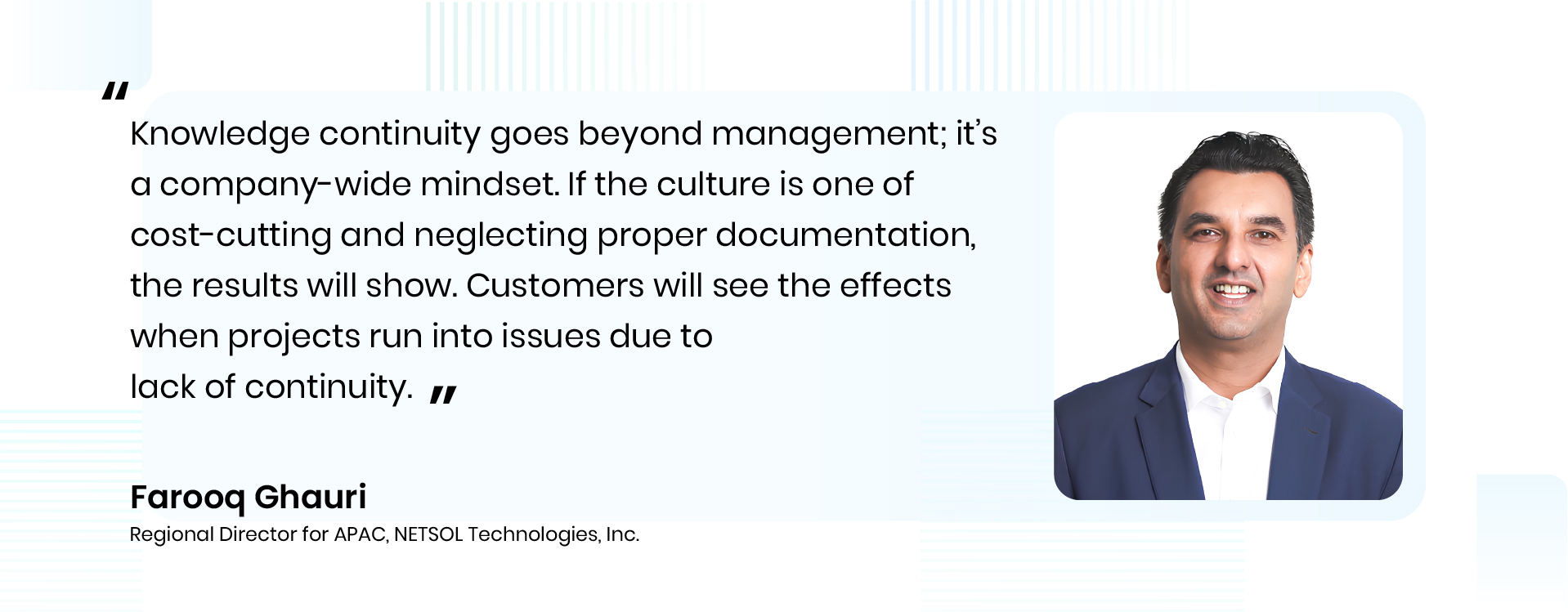
This leadership support is essential for ensuring that knowledge continuity is prioritized across all levels of the organization.
Conclusion
As Farooq Ghauri concludes:
“Knowledge continuity isn’t just about avoiding risks; it’s about using continuity to build stronger, more resilient teams that can scale, adapt, and thrive under pressure.”
By implementing shadowing, documentation, and knowledge-sharing strategies, NETSOL ensures that its projects remain on track, even when team members come and go. With the right tools, practices, and mindset, asset finance companies can safeguard their institutional knowledge, ensuring smoother transitions and more successful project outcomes.
For organisations building the strategic foundations that make knowledge continuity sustainable across multi-year projects, the whitepaper on the importance of strategic clarity provides a practical framework for maintaining alignment between leadership, vendor teams, and delivery teams across complex, long-term technology transformations.
To dive deeper into these strategies and learn how NETSOL ensures continuity across complex asset finance projects, listen to the full knowledge continuity podcast with Farooq Ghauri.

If you're in BFSI (Banking, Financial Services, and Insurance), standing still isn't an option.
Related blogs

Blog
What a wholesale lending platform lets you say yes to

Blog
NETSOL is ready for Palm Desert: Transcend Finance to take center stage at ELFA 2026
Blog