Blog
Wholesale finance and retail finance meet at the payoff
By NETSOL Technologies , on August 13, 2026
See how connecting wholesale and retail auto finance helps lenders link vehicle inventory, payoffs and retail contracts while reducing reconciliation.
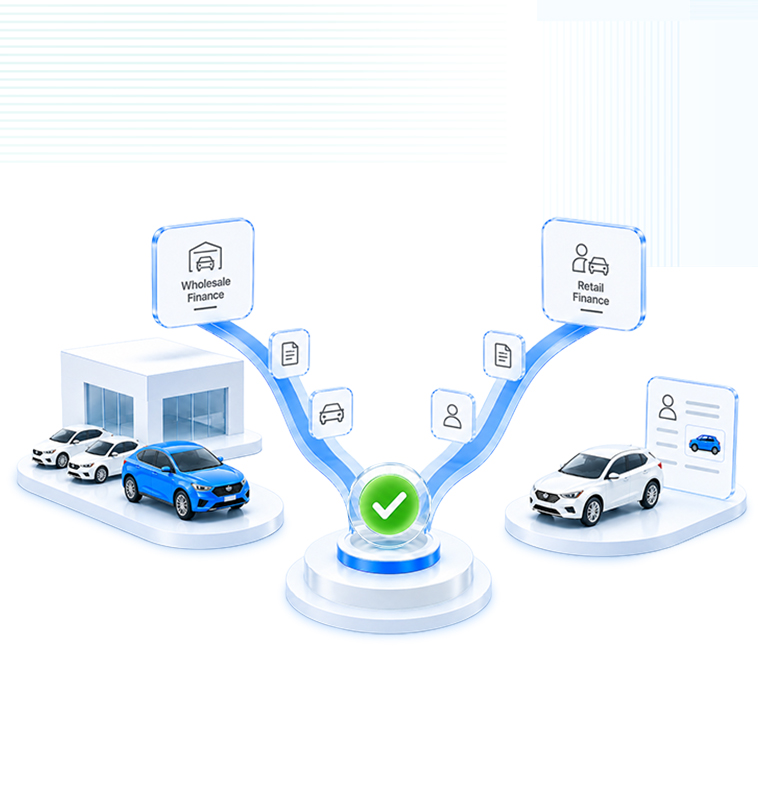
Table of Contents
Subscribe to our newsletter
Share this Blog:


The same car gets financed twice. First to the dealer as stock, then to the customer who drives it away. Two contracts, two books, two teams. In most lenders they are also two systems. The only moment they have to agree is the moment the car is sold.
Wholesale finance is inventory funding for a dealer's stock, and retail finance funds the buyer. Running them on separate platforms means nobody can match one record to the other at the point of sale. The unit is settled retail while it is still recorded as floorplan, and somebody reconciles the difference later by hand.
Where wholesale finance and retail stop agreeing
A wholesale ledger tracks units. A retail ledger tracks contracts. The same split runs through credit risk management software for auto lenders. Those are different objects, and the vehicle is the only thing they share.
When a dealer sells a floorplanned unit, three things should happen together. The retail contract is written. The floorplan advance on that unit is paid out. The stock record is closed. On one platform that is a sequence. On two platforms it is a reconciliation.
The cost shows up in three places. Ageing keeps accruing on a car that has already gone. Curtailment, which is the scheduled paydown on a floorplanned unit, is charged on stock the dealer no longer holds. An audit then finds a unit missing when it was simply sold three weeks ago and never matched off.
What shared visibility actually means
Shared visibility is usually described as a dashboard. In practice it means one identifier for the vehicle and one for the dealer, held in the same place. Inventory funding and the retail contract then point at the same car rather than at two records that resemble each other.
With that, your dealer manager can see a dealer's floorplan exposure and their retail volume in the same view. Ageing stock and slow retail conversion are the same story told twice, and a dealer whose units are ageing is usually a dealer whose retail submissions have also gone quiet. Two systems make that two conversations.
It also changes what an audit is for, in the same way AI-assisted credit decisioning changes what a credit team can show afterwards. A floor check that reconciles against live retail settlements finds the genuinely missing unit, rather than producing a list of exceptions that turn out to be timing.

Figure. One vehicle across two books, showing where the handover is a sequence and where it becomes a reconciliation.
The lifecycle is longer than either book
End-to-end usually means origination through servicing. In a dealer network it starts earlier, because the vehicle was on your balance sheet before the customer ever saw it.
That gives a lender something a retail-only view cannot produce. You know how long the unit sat, what the dealer paid to hold it and what the customer eventually paid for it. That is the full economics of one vehicle across two products, and it is only assemblable if both records live together.
It matters most when things go wrong. A dealer under stress shows it in stock ageing before it shows in retail arrears, and a lender who can see both has warning that a lender with two systems does not.
What this means for lending leaders
- Treating the payoff as the control point between the two books, since that is the one moment where a mismatch becomes a real exposure
- Holding one vehicle identifier and one dealer identifier across wholesale finance and retail, because shared visibility is an identity problem before it is a reporting one
- Reading stock ageing as an early signal on a dealer, rather than waiting for retail arrears to confirm it
Frequently asked questions
Why run wholesale finance and retail finance on one platform?
Because the same vehicle passes through both, and the handover between them is the point where money is at risk. One platform makes that a sequence. Two platforms make it a reconciliation somebody has to perform.
What breaks when they are separate?
Ageing and curtailment keep running on units that have already been sold. Floor checks flag exceptions that are only timing differences. Nobody can see a dealer's stock position and retail performance in one place.
Stock ageing tells you about a dealer before arrears do
Lenders tend to watch the retail book, because that is where losses are recorded. The earlier signal sits in the wholesale book, in units that are not moving and payoffs that arrive late.
In Transcend Finance for automotive finance the wholesale finance system and retail origination sit on the same core, with mDealer giving dealers their inventory position and mAuditor recording audit exceptions against the same stock record. If you are carrying both books on separate systems and reconciling by hand, we are happy to compare notes.

If you're in BFSI (Banking, Financial Services, and Insurance), standing still isn't an option.
Related blogs

Blog
Wholesale finance implementation that lasts beyond go-live

Blog
NETSOL heads to Digital Dealer 2026: Bringing Transcend Retail to Detroit
Blog