Blog
Automotive digital retailing only works if the desk can close the deal
By NETSOL Technologies , on August 18, 2026
Discover why automotive digital retailing depends on accurate payments, incentives, taxes, fees, and trade values that carry seamlessly from the website to the F&I desk.
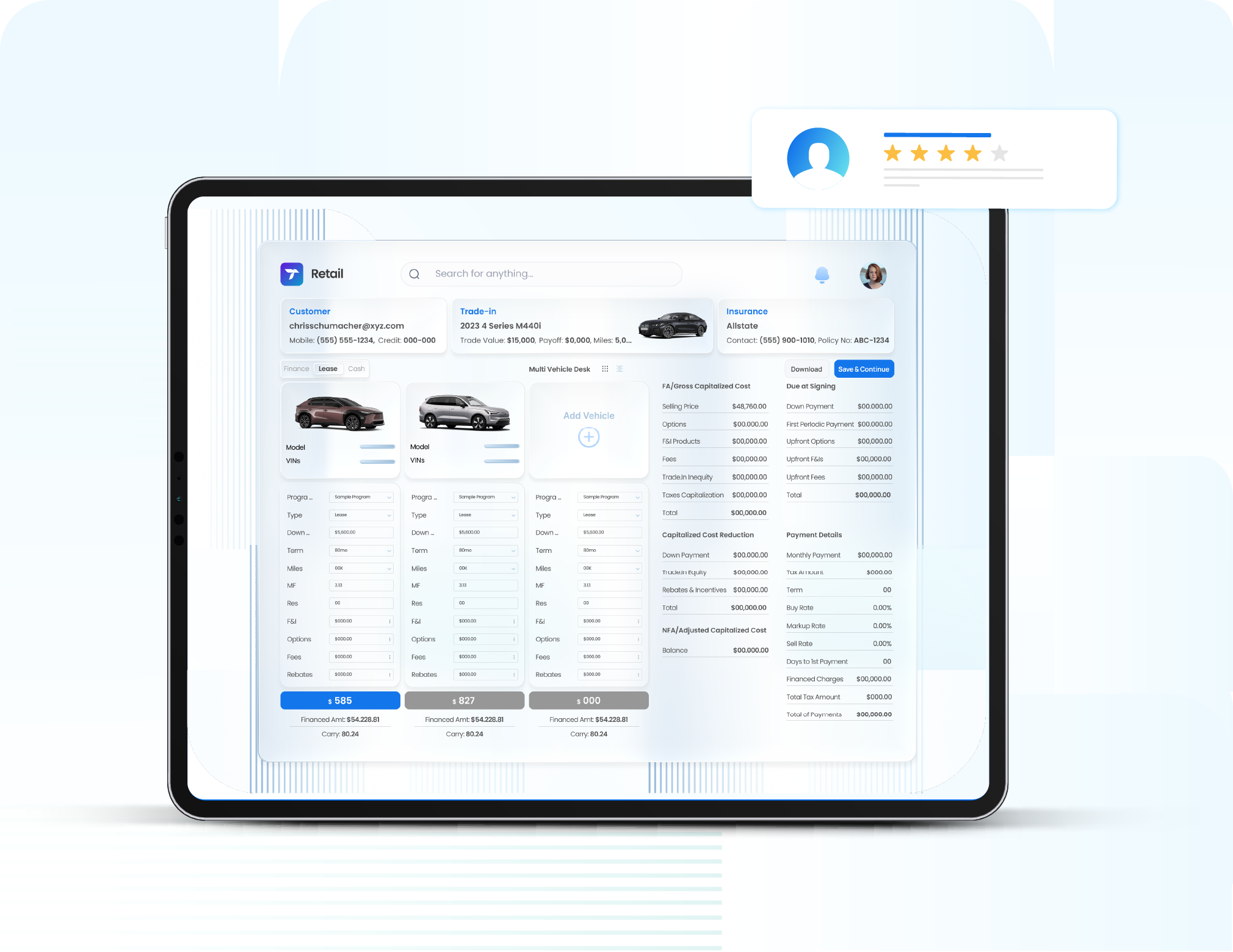
Table of Contents
Share this Blog:


The payment on your website is a promise your desk has to keep
A shopper builds a deal on your site at 11 at night. Rebate applied, trade allowance in, tax and fees included, 60 months. The number looks fair and the tool that produced it is quick and good looking. It is also some way off what your finance office can actually write. Nobody knows that yet, and the shopper is already attached to the figure.
Most car buying tools are judged on how the website looks and lost on what it calculates. That gap between the website's number and the desk's number is exactly what happens when the payment calculator lives apart from the F&I desking tool. Two things decide whether the payment on the screen survives the desk. Whether the manufacturer's incentive rules were applied properly, and whether tax and fees were worked out for the customer's own state rather than guessed at.
A rebate is not subtraction
Rebates behave like rules, not like discounts.
They stack and they cancel each other out. They depend on which finance product the customer takes, they run on their own expiry dates, and some of them turn on who the buyer is. Swap cash back for the manufacturer's special rate and the eligible set changes. Add a loyalty offer and one of the others can drop away.
A tool that holds incentives as a list of dollar amounts will produce a payment that looks perfectly reasonable and that the lender will not approve. Your customer does not read that as a software limitation. They read it as a quote that changed.
Tax and fees are where guessing gets expensive
Vehicle tax in the United States is not one calculation. It is thousands of them.
Rates and rules change by state and often by county or city inside it. Trade-in credit works differently from place to place. Lease tax can follow the monthly payment instead of the price of the car. Doc fees and DMV fees vary again, and some states cap what you can charge.
None of this is news to a finance office, which is exactly the point. Your desk has always known it. When your website estimates what your desk calculates, you have built a gap into the deal. Every shopper who walks through it arrives holding the wrong number.

The engine underneath is what decides it
The website is the part everyone sees. What decides whether it holds up is the calculation layer underneath, and that is a finance problem rather than a web design problem. It is the same question underneath automotive digital retailing.
NETSOL has four decades of experience in automotive finance and leasing, built alongside OEM captives, banks and independent lenders. That matters here for one narrow reason. The incentive and tax logic your shopper needs is the same logic a captive already runs on its own contracts, and it is easier to put that engine behind your website than to rebuild an approximation of it.
That is what payment governance means in practice. Your website and your desk work to one set of rules instead of two.
What this means for dealership and dealer group leaders
- Judging a car buying tool on whether its payment survives the finance office, not on how the website looks
- Making incentive eligibility and stacking rules the platform enforces, since a rebate applied wrongly is a quote you have to take back
- Working out tax, doc fees and DMV fees for the customer's own state instead of estimating them, because the difference turns up at signing
Frequently asked questions
Why does the online payment differ from the number at the desk?
Usually because the online tool estimated the rebate stack, the tax treatment or both. An estimate is close enough to look right and far enough off to cost you a conversation nobody wanted.
What should a car buying tool work out before it shows a payment?
Which incentives that customer actually qualifies for on that finance product. Tax for their state, including how the trade-in is treated. Doc and DMV fees. Anything left as an estimate becomes a difference your desk has to explain.
The number is the promise
Everything else online is a presentation. The payment is the only part your customer treats as a commitment, and it is the part most easily got wrong by software built as a website rather than as a finance system.
Transcend Retail carries the payment build, trade valuation, credit steps and F&I selection into your dealership systems without re-keying, so the figure a shopper sees comes from the same rules your desk works to. There is a simple way to find out where you stand. Build a deal on your own site tonight, take it to the desk in the morning and see whether the payment moves. We are happy to compare notes.

Related blogs

Blog
A dealer portal is how you see your own channel

Blog
In asset finance software the asset record is the whole chain
Blog