Rightsizing in asset finance: Lessons from the field
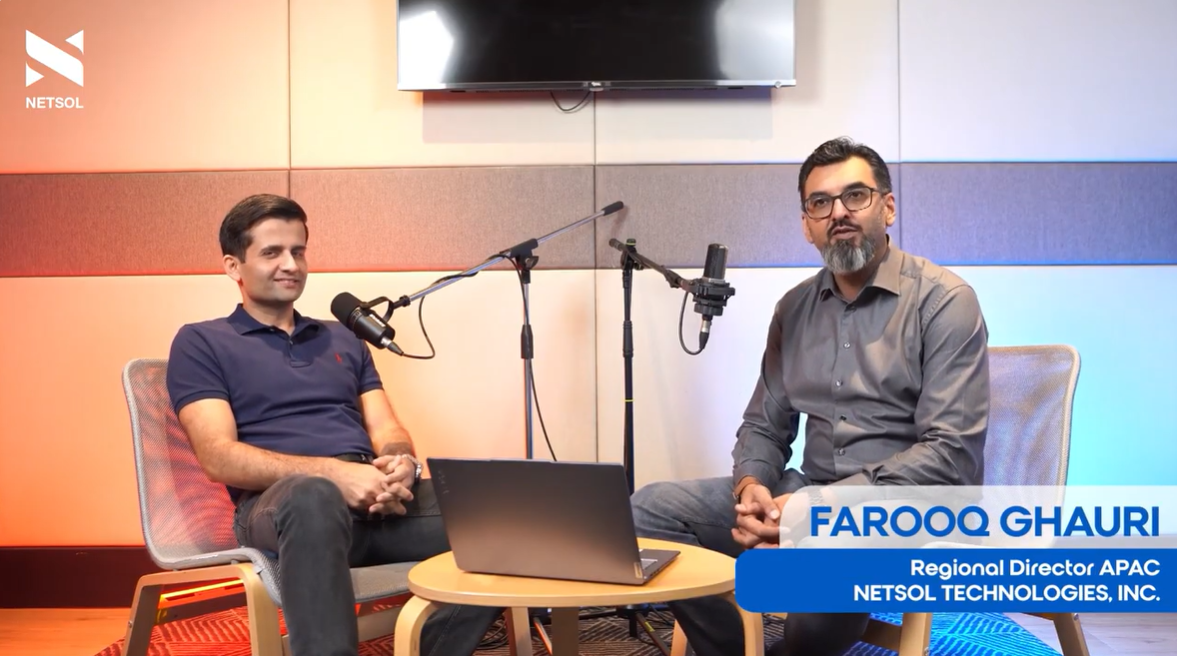
In this episode of the NETSOL Podcast, Farooq Ghauri, Regional Director APAC, sits down with host Adzra Zulkifli to examine one of the most consistently underestimated risk factors in large-scale asset finance delivery: getting the team size wrong. Drawing on over 22 years of experience and more than 200 implementations of the Transcend implementation platform and its predecessor platforms across global markets, Farooq unpacks what rightsizing actually means in practice, not headcount optimisation, but matching capability, timing, and context to the genuine demands of each phase in a multi-year programme. As he puts it directly: "In an industry where projects can span years, geographies, and millions in investment, getting the team size right isn't just a matter of efficiency; it's a matter of survival."
About this episode
Asset finance implementations are among the most resource-intensive technology programmes an organisation will manage. They span multiple years, involve complex integrations across credit, collections, dealer, and OEM systems, and require sustained coordination between vendor teams, client teams, and executive sponsors who each operate under different pressures and timelines. In this environment, resource planning decisions made at the outset, or not made, propagate through the entire programme. Overstaffed projects stall under coordination overhead. Understaffed projects miss milestones and accumulate technical debt that surfaces at go-live.
Farooq's framework for asset finance system delivery is grounded in four decades of collective NETSOL performance data across project types, geographies, and asset classes, data that forms the baseline from which every implementation plan is built. This episode examines that framework directly, with real examples from APAC implementations.
What you'll learn
This episode is built for implementation leaders, delivery directors, programme sponsors, and operations executives at asset finance companies preparing for or currently managing large-scale platform deployments. It covers:
- Why rightsizing is a structural problem, not a staffing problem and how treating it as the latter produces the errors that cost projects the most.
- The two-dimensional framework Farooq uses to plan resourcing: historical benchmarks from NETSOL's delivery data, and structured anticipation of the unknowns that no two implementations share.
- Why budget constraints set before scope is understood are one of the highest-risk decisions a programme sponsor can make and how to engage vendors early enough to avoid them.
- How phased delivery, as demonstrated in a two-country, six-product implementation across Australia and New Zealand, can reduce duplication, protect local nuance, and produce faster training cycles without compromising quality.
- The hidden backbone of resource management: communication architecture across working level and executive level, and why multi-layered governance models outperform flat ones in complex, multi-year programmes.
Key themes from the discussion
Three principles anchored the conversation:
Rightsizing is an art and a science. Farooq's framing is deliberate on this point. The science is the data, NETSOL's four decades of implementation benchmarks give a starting baseline for what a given programme type, geography, and scope combination requires. The art is everything the data cannot predict: client maturity, regulatory surprises, market shifts mid-programme, and the human dynamics of teams under delivery pressure. The companion blog on rightsizing in asset finance covers the full framework, including Farooq's Australia and New Zealand example in detail, a two-country, six-product, phased go-live that reduced duplication and testing overhead without sacrificing regulatory compliance in either market.
Budgets should enable rightsizing, not constrain it. One of the most direct moments in the episode is Farooq's challenge to the common practice of defining a fixed budget before engaging a vendor on scope. The instinct is understandable, finance teams need numbers, and programmes need guardrails. But a budget set without understanding the actual complexity of the implementation systematically creates either overstaffed projects that stall or understaffed ones that fail quietly. The Maple Commercial implementation success shows what well-calibrated resource planning looks like in practice for an Australian asset finance startup deploying in Farooq's region, a fast, cloud-based implementation where vendor and client capability were matched precisely to what the programme demanded.
Whether you have too many people or too few, the impact carries all the way post go-live. This observation from Farooq is one of the sharpest in the episode. Resourcing decisions are not contained to the delivery phase, they shape the quality of testing, the pace of knowledge transfer, the depth of user training, and ultimately the operational performance of the platform in production. Programmes that look like they have delivered on time can fail slowly after go-live because the resource shortcuts made during implementation were never visible in a milestone report.
Going deeper: Related reading
Leasing Life covered NETSOL's South Korea go-live in April 2024, the 11th market in a 9-year, 12-country contract, demonstrating what sustained, well-rightsized delivery looks like when a team adapts consistently across regulatory challenges, complex integrations, and the unexpected disruptions that multi-year programmes inevitably encounter.
Related podcasts
Data Migration in Asset Finance: Strategies, Pitfalls & Real-World Insights

Navigating change management in long-term projects - Lessons from the field (episode 3)

Strategy with Jason podcast featuring NETSOL's Adam Bruttell (Digital auto retail)