Blog
Future-proofing financial operations: Why API integration scales vendor partnerships
By NETSOL Technologies , on December 26, 2025
How API-first integration enables banks and asset finance firms to scale vendor partnerships, accelerate digital transformation, and future-proof financial operations.
Table of Contents
Share this Blog:


In today’s fast-evolving financial landscape, staying ahead means staying connected. Banks, fintechs, and asset finance system firms are juggling more third-party services than ever, from digital identity verification and e-signatures to payment gateways and data analytics tools.
As a CIO or CTO, you’re tasked with future-proofing your organization’s operations so that new innovations and partnerships can be embraced without overhauling core systems. How can this be achieved? The answer lies in building an integration-first strategy.
By leveraging modern APIs (Application Programming Interfaces) to seamlessly connect with external vendors, financial institutions can scale partnerships, enhance agility, and deliver better customer experiences.
The API revolution in financial services
APIs have emerged as the connective tissue of modern finance, enabling disparate software and services to talk to each other instantly and securely. In recent years, financial institutions have wholeheartedly embraced APIs as a means to accelerate digital transformation.
Over 85% of banks have adopted open banking interfaces to give trusted partners access to data and services, fueling a wave of new apps and integration.
Why this API boom? Simply put, APIs enable speed and flexibility. They allow banks, lessors, and fintechs to rapidly plug in new capabilities without rebuilding systems from scratch.
For a focused look at how this plays out specifically in automotive retail operations, the blog on API-first in auto retail examines why API-first architecture is becoming the non-negotiable foundation for dealer and OEM digital transformation.
“APIs are crucial for modern digital businesses because they allow different software systems to communicate and exchange data seamlessly, and they are foundational to how modern applications are built."
Scaling vendor partnerships through seamless integration
Financial institutions thrive in ecosystems of fintech partners for payments, identity, origination, and engagement. Partnerships only deliver value with seamless integration; many underperform due to manual work and one-off code. An API-led approach or Hubex integration platform lets teams onboard vendors in weeks, not months, and launch faster.
Secure, real-time data flows remove re-entry and errors, creating a unified operational view (e.g., instant payment status updates). Priority areas, payments, fraud/risk, and wallets, sit at the transaction core and demand tight links. Banks are investing heavily in digital transformation, making integration and automation top priorities. Future growth hinges on partnerships and partnerships hinge on easy integration.
Key integration areas in asset finance
Scaling vendor partnerships is especially vital in the asset finance and leasing industry. These firms must coordinate a wide array of external services throughout the customer and asset lifecycle. Below are some of the key integration areas for asset finance operations and what they enable: 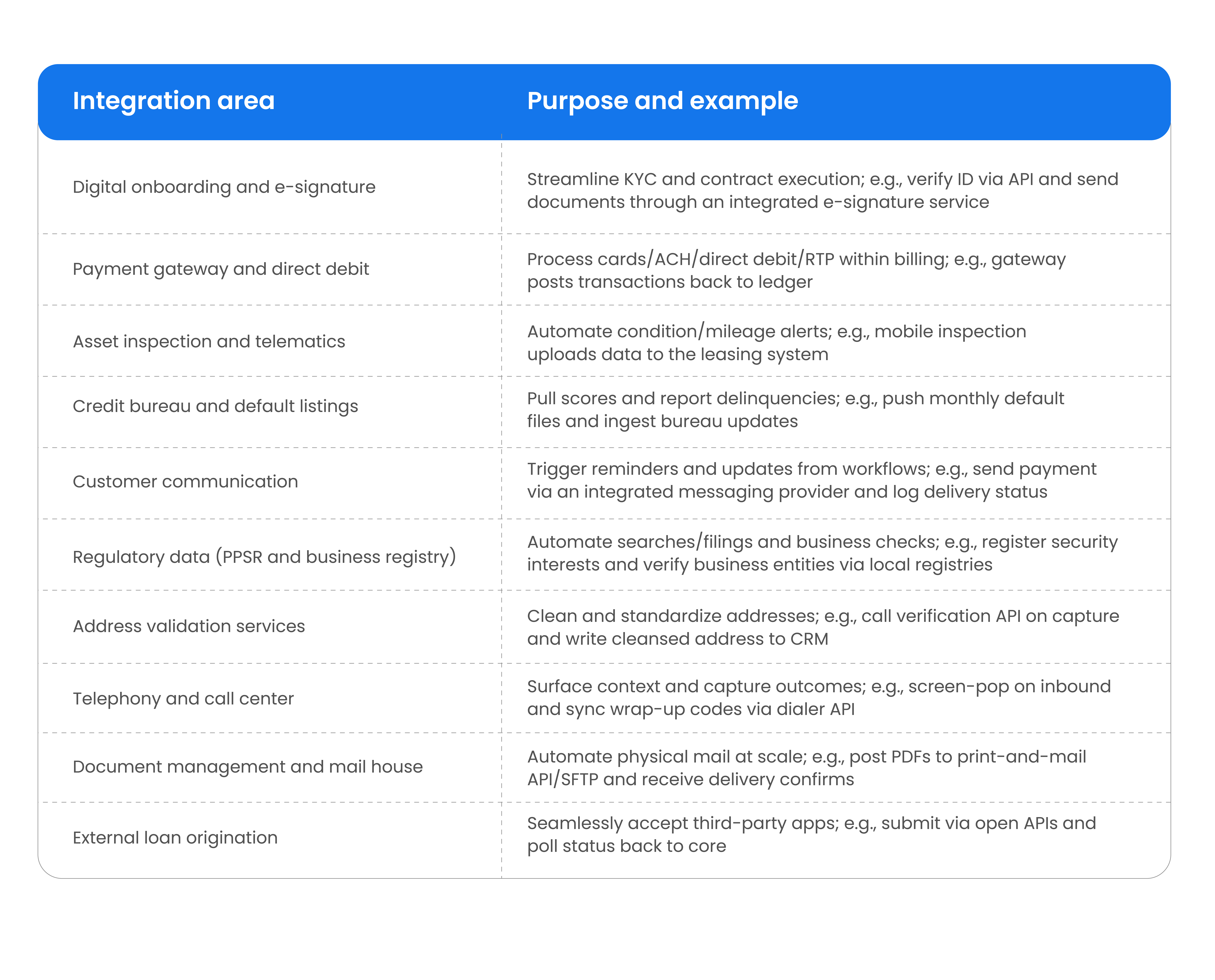
NETSOL's work on eliminating calculation discrepancies demonstrates what a live API deployment delivers in practice, removing calculation errors and reducing onboarding time to five minutes through Flex, NETSOL's API-based calculation engine now deployed across multiple UK financial institutions.
The asset-finance platform is a hub connecting specialist vendors across the lifecycle. Broad, API-first integrations prevent fragmentation and reduce compliance risk. With them, you scale faster, cut errors, and deliver a seamless customer experience.
Benefits of API-driven integration
Building a strong API integration framework isn’t just an IT project, it’s a strategic investment that yields significant benefits across the organization.
1. Efficiency and cost savings
By enabling automated, real-time data exchange between systems, API integration cuts down manual workloads and custom one-off interfaces, directly lowering operational costs.
2. Faster time to market
APIs allow financial firms to launch new services faster by reusing and combining capabilities. This agility is crucial for quickly responding to market opportunities and customer demands.
3. Improved partner collaboration
API integrations strengthen partnerships by ensuring that the workflow between the financial institution and the vendor is seamless. Both sides can exchange information in real time, leading to better coordination.
4. Enhanced customer experience
API integrations keep data synchronized across channels, so customers get up-to-date information and faster service. Integration is the key to eliminating the friction points that often frustrate customers.
5. Better decision-making and insights
When systems are connected through APIs, data flows into central analytics tools and dashboards, providing leaders with a holistic, real-time view of the business. This integration of data enables more informed decision-making.
6. Security and compliance at scale
Contrary to the notion that more integrations mean more risk, a well-governed API ecosystem can actually enhance security and compliance. Modern API management tools offer encryption, authentication, and monitoring features that keep data exchanges secure.
NETSOL’s integration advantage
NETSOL Technologies, a global leader in asset finance and leasing software, has built its Transcend platform around an around an API-first approach, a centralized framework that connects banks and finance companies to fintech partners without heavy custom development.
This hub enables seamless integration across key areas like onboarding, payments, asset management, credit, communications, and regulatory checks, empowering CIOs and CTOs to scale operations faster and adopt new partnerships effortlessly.
Key integration highlights:
- Digital onboarding and e-signature: Pre-built connectors for services like DocuSign enable secure, automated KYC and contract signing.
- Payments and real-time transactions: Out-of-the-box support for ACH, direct debit, and real-time payment gateways for instant reconciliation.
- Asset and end-of-lease management: Integrates with inspection apps and remarketing tools to automate condition reporting and next steps.
- Credit and regulatory interfaces: Supports integrations with major credit bureaus and local regulatory bodies for identity verification, business registry checks, and security interest filings, using pre-configured accelerators to simplify compliance across markets.
- Customer communication and telephony: Connects with Twilio or similar APIs for SMS/email alerts, click-to-dial, and screen-pop call management.
Conclusion
In asset finance and lending, seamless integration with external partners is now a strategic differentiator, not just an IT task. API-led integration lets institutions plug into the fintech ecosystem, scale services through partnerships, adapt quickly, and still maintain a single source of truth.
Firms stuck with manual processes and siloed legacy systems should define their key partner touchpoints, ensure APIs or middleware exist at those points, and adopt an “API-first” mindset.
The winners in 2025 and beyond will be those that collaborate best with fintech, regtech, and embedded finance partners, using robust integration to orchestrate and scale innovation, efficiency, and value for customers.
For a comprehensive framework on how financial institutions can build and execute an API-first integration strategy, the whitepaper APIs in financial services covers the architecture, vendor evaluation, and deployment considerations that determine whether API adoption delivers lasting competitive advantage. Asset Finance Connect covered NETSOL's API-first approach in asset finance in detail, providing industry context on why the shift from end-to-end platforms toward modular API-based solutions is reshaping how financial institutions build and scale their technology stacks.

If you're in BFSI (Banking, Financial Services, and Insurance), standing still isn't an option.
Related blogs

Blog
The payment on your website is a promise your desk has to keep

Blog
A dealer portal is how you see your own channel

Blog