Blog
Cyber resilience in APAC: Why 2026 demands more than traditional defence
By NETSOL Technologies , on May 11, 2026
APAC organisations face rising cyber threats in 2026. Learn how stronger cyber resilience improves detection, response, recovery, and business continuity.

Table of Contents
Subscribe to our newsletter
Share this Blog:


“The question is no longer whether cyber threats will impact your industry, but whether your security foundations are strong enough to withstand and recover from them.”
That line captures the new cybersecurity reality for APAC.
Across the region, organisations are growing digitally, expanding cloud adoption, working across borders, and managing more complex technology ecosystems than ever before. But as businesses become more connected, attackers are also becoming faster, more automated, and harder to detect.
The numbers are difficult to ignore. The global average cost of a data breach is now estimated at USD 4.44 million. The fastest recorded eCrime breakout time is just 51 seconds. The global median dwell time still stands at 11 days, meaning attackers can remain inside environments long enough to explore systems, escalate privileges, and prepare for disruption.
For APAC organisations, this is not just a security concern. It is a business continuity issue.
APAC’s threat landscape is changing fast
Cybersecurity in APAC is becoming more complex because the region is not one single operating environment. Organisations are managing different regulatory expectations, data protection regimes, cloud strategies, and cross-border operations. Singapore, Australia, Indonesia, Thailand, China, and other regional markets each bring their own compliance and operational realities.
At the same time, cybercrime is growing in both scale and financial impact. According to the Australian Signals Directorate’s Annual Cyber Threat Report 2024–25, a cybercrime is reported in Australia approximately every six minutes. According to the Singapore Police Force’s Annual Scams and Cybercrime Brief 2024, Singapore recorded 51,501 scam cases in 2024, with total losses increasing to at least S$1.1 billion.
These figures show that cyber risk is no longer limited to large enterprises or highly regulated sectors. It is now a regional business risk affecting financial institutions, technology providers, manufacturers, retailers, public sector organisations, and fast-growing digital businesses.
And the attack methods are evolving.
Modern attackers are not always forcing their way in through obvious malware. Increasingly, they are using stolen credentials, identity abuse, cloud misconfigurations, and legitimate system tools to move quietly through enterprise environments.
“The most damaging consequences of a cyberattack often occur not at the moment of initial intrusion, but during what follows.”
That “what follows” is where the real business damage begins.
The real danger starts after initial compromise 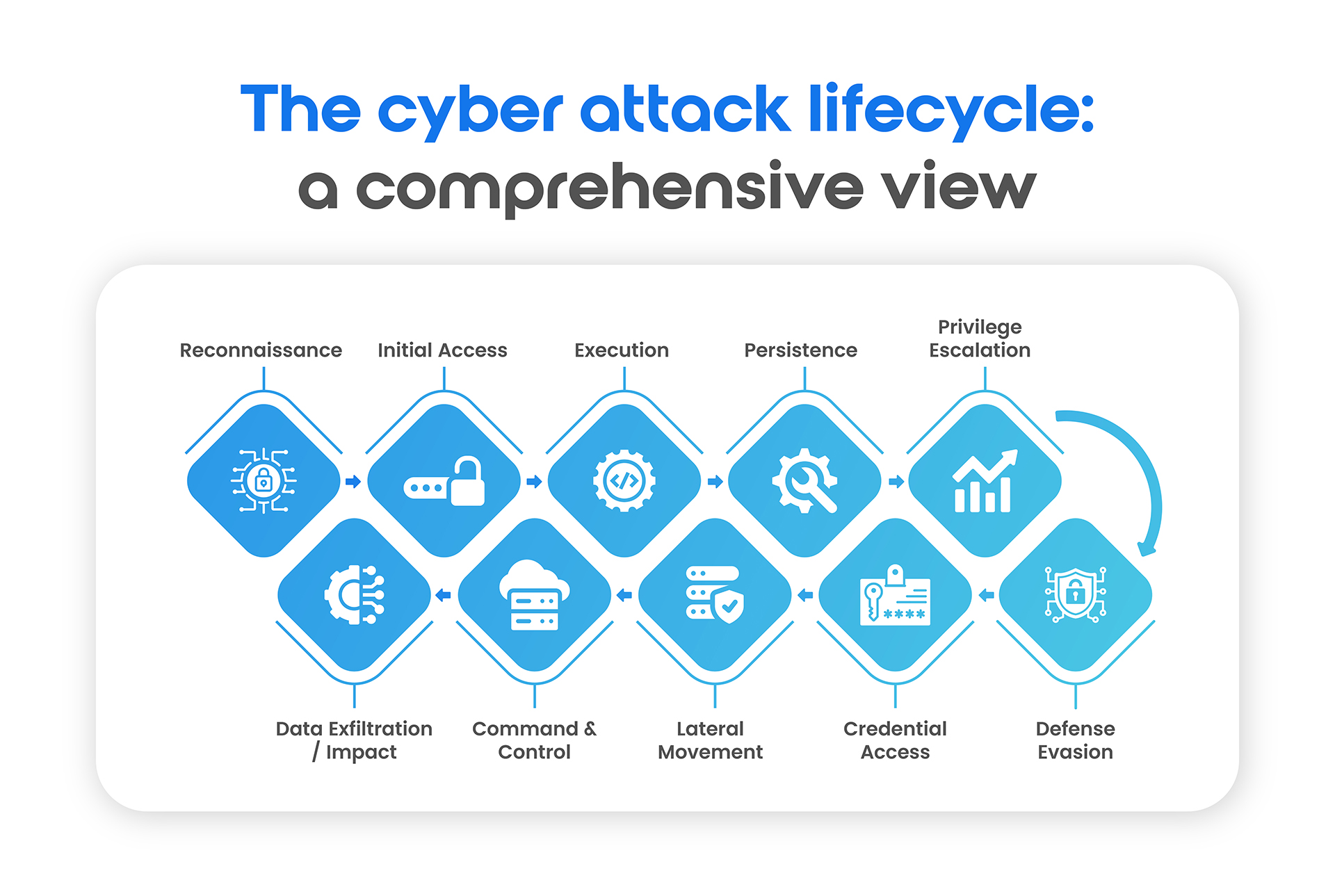
Most successful cyberattacks follow a familiar pattern: reconnaissance, initial access, execution, persistence, privilege escalation, defence evasion, credential theft, lateral movement, command and control, and finally data exfiltration or operational impact.
For financial institutions evaluating how to secure their data infrastructure in the cloud, the webinar on securing financial data examines how centralised data security architecture can provide visibility and control across complex multi-cloud environments.
The challenge is that attackers now move through these stages much faster.
Once inside a network, they look for weak identity controls, excessive privileges, flat network structures, unmonitored endpoints, exposed cloud services, and fragmented security tools. If these gaps exist, attackers can move laterally, access high-value systems, and increase the blast radius of the breach.
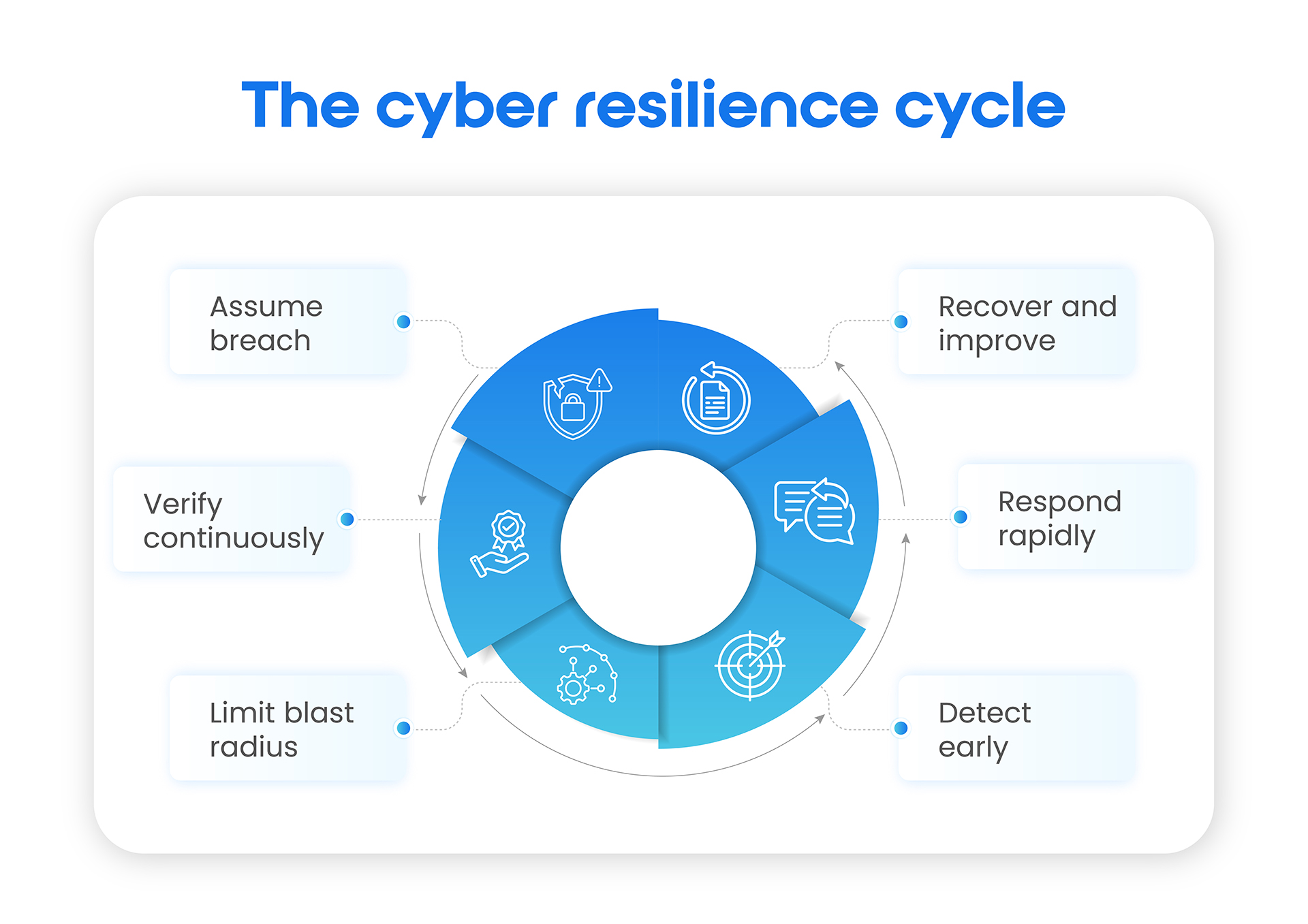
This is why businesses operating in APAC cannot rely only on prevention. Prevention matters, but it is not enough. The stronger question is: how quickly can the organisation detect, contain, and recover?
The biggest gaps attackers continue to exploit
Many organisations still carry foundational weaknesses that make attacks more damaging than they need to be.
Flat networks allow attackers to move across systems once they gain access. Excessive privileged access gives compromised accounts too much power. Limited endpoint and cloud visibility delays detection. Untested incident response plans increase confusion during a crisis. Treating cybersecurity as only an IT issue prevents the business from preparing for operational disruption.
For business leaders, these are not technical problems in isolation. They create direct business consequences: downtime, regulatory exposure, customer trust erosion, financial loss, and reputational damage.
One powerful example comes from Japan. In an NPA survey 49% of ransomware victims said it took at least a month to recover data.
That is the cost of weak resilience: not just being attacked but being unable to recover quickly.
What APAC organisations should prioritise now
The path to ransomware cyberattacks in financial services does not need to begin with a large, overwhelming transformation. It can start with focused, practical action.
First, organisations need to identify what must be protected. This includes critical systems, sensitive data, business-critical processes, users, services, and machine identities. Without this visibility, it is difficult to prioritise security investment.
Second, they need to reduce the attack surface. This means removing unnecessary exposure, tightening access controls, reviewing privileged accounts, and segmenting networks so that attackers cannot move freely if one area is compromised.
Third, they need to strengthen detection and response. Security teams need clear visibility across endpoints, identities, cloud environments, and network activity. The faster an organisation identifies suspicious activity, the greater its ability to contain damage.
Fourth, incident response plans must be tested regularly. A plan that only exists in a document is not enough. Organisations should run tabletop exercises, simulations, and recovery drills to ensure teams know what to do when an attack happens.
Finally, information security services must be aligned with business continuity. Security controls should protect the systems and processes that matter most to business operations.
The business case for resilience
Cyber resilience is not only about reducing risk. It is also about protecting growth.
APAC businesses are investing heavily in digital transformation, cloud platforms, automation, AI, and connected customer experiences. But these initiatives depend on trust. Customers need to trust that their data is protected. Regulators need to see responsible controls. Executives need confidence that growth will not be interrupted by preventable security failures.
Once resilience becomes operational, security shifts from reactive firefighting to “a strategic enabler of business continuity and growth.”
That is the real opportunity.
Cybersecurity should not sit at the edge of the business. It should be built into how the business operates, scales, and protects value.
Final takeaway
For businesses in APAC, 2026 will demand a stronger, more practical approach to cybersecurity. Threats are faster. Regulatory expectations are rising. Digital ecosystems are more complex. Attackers are exploiting identity, visibility, and response gaps with increasing precision.
The organisations that succeed will not be the ones that assume they can stop every attack. They will be the ones prepared to detect faster, contain earlier, recover stronger, and improve continuously.
For organisations integrating AI into their security operations, the whitepaper on client data and AI trust covers the governance framework for deploying AI with the transparency and ethical controls that APAC regulators increasingly expect.
Is your organisation ready to withstand the 2026 threat landscape?
Connect with Transcend Consultancy to assess your cyber resilience maturity, identify high-priority security gaps, and build a practical roadmap for stronger detection, containment, and recovery across APAC.

If you're in BFSI (Banking, Financial Services, and Insurance), standing still isn't an option.
Related blogs

Blog
What a wholesale lending platform lets you say yes to

Blog
NETSOL is ready for Palm Desert: Transcend Finance to take center stage at ELFA 2026
Blog